
Click on image to view the full photo gallery
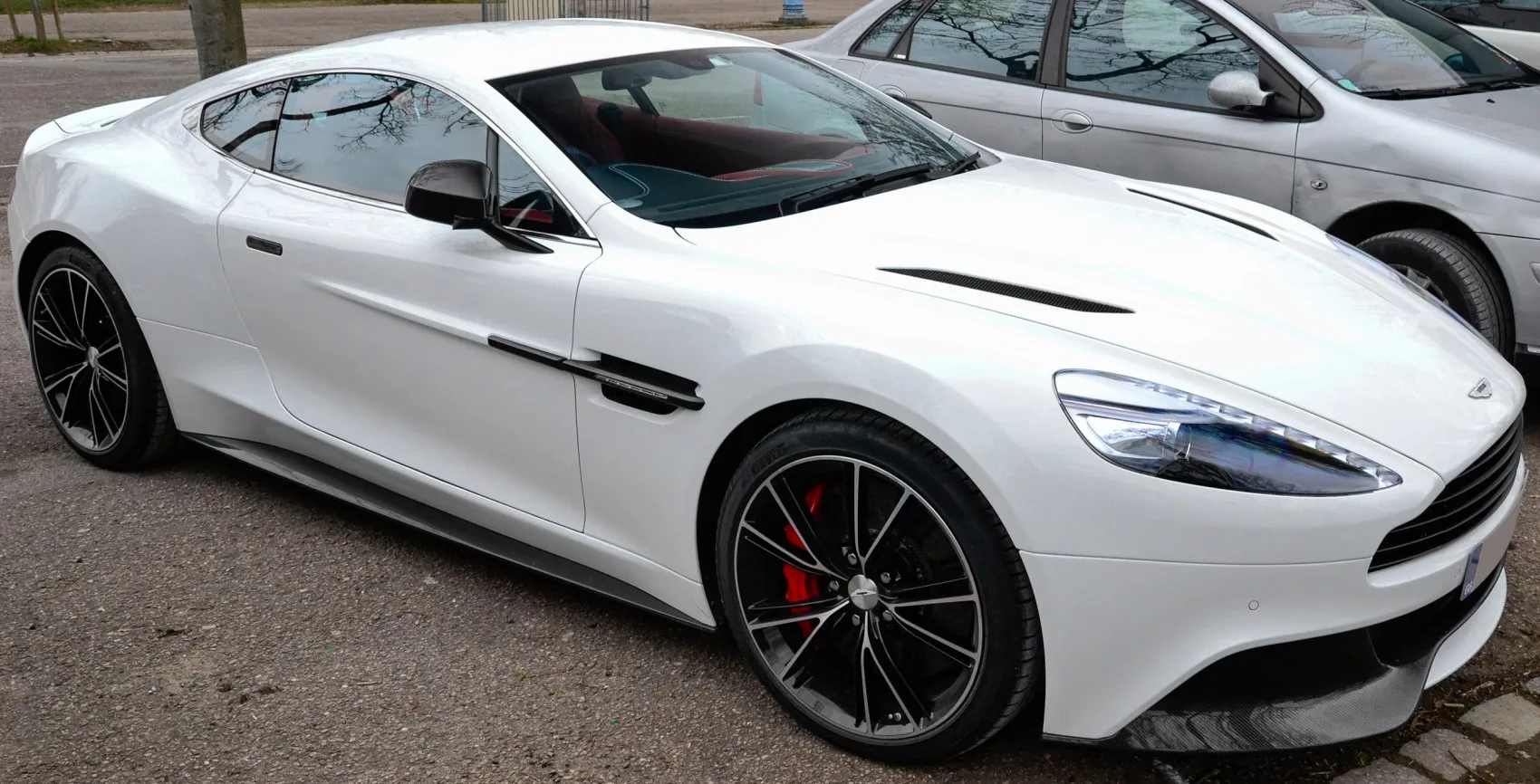
Aston Martin Vanquish III 5.2 V12 (835 Hp) ZF
Overall Rating
Aston Martin Vanquish:
The Aston Martin Vanquish is a grand tourer introduced by British luxury automobile manufacturer Aston Martin in 2001 as a successor to the Aston Martin Virage.
The Aston Martin V12 Vanquish was designed by Ian Callum and unveiled at the 2001 Geneva Motor Show. It was produced from 2001 to 2007 as the flagship of the marque. A concept car, known as "Project Vantage", and the first Aston Martin design wholly designed by Callum, was built to display the company's vision for a future sports car that could represent Aston Martin's aspirations after the discontinuation of the Virage-based Vantage. The concept car evolved directly into the V12 Vanquish, and featured a carbon fibre and alloy structure, Aston Martin's most powerful V12 engine, and a host of new technologies. A specially modified V12 Vanquish was driven by James Bond in the 2002 film Die Another Day. In 2004, a mildly updated version of the first-generation model, named "V12 Vanquish S", was introduced, featuring a more highly tuned engine and more track-oriented ride and handling. The V12 Vanquish was indirectly replaced by the DBS after 2007....(Read more on Wikipedia)
III Overview:
Aston Martin Vanquish (III). With 1000 Nm of torque, it offers ample pulling power. With a weight of 1910 kg, it falls in the mid‑range. Rear‑wheel drive offers dynamic handling and sporty feedback. Acceleration is excellent (0–100 km/h in 3.3 s). The top speed reaches 345 km/h. A two-door car with a fixed roof, known for its sporty design and dynamic performance. Seating for 2 makes it ideal for daily use.
5.2 V12 (835 Hp) ZF Verdict:

Performance Verdict
An incredibly potent twin-turbo V12 delivering immense power and torque across a broad rev range, ensuring blistering acceleration (0-100km/h in 3.3s) and a thrilling top speed (345 km/h) befitting a super GT.
Fuel Economy
As expected for a high-performance V12, fuel consumption is significant, particularly in urban driving (26.2 l/100 km low speed WLTP), reflecting its focus on power over efficiency with a combined WLTP of 13.7 l/100 km.
Pros and Cons:
Pros:
- • Exhilarating V12 BiTurbo performance and sound.
- • Stunning, aggressive yet elegant design.
- • Luxurious, driver-focused interior with premium materials.
- • Exceptional high-speed stability and handling.
- • Exclusivity and brand prestige.
Cons:
- • Very high purchase price and running costs.
- • Significant fuel consumption, especially in city driving.
- • Limited practicality with only two seats and modest trunk space.
- • Potentially firm ride for some, despite GT aspirations.
Specifications:
Specifications are compared to those of the previous generation(III Volante: March, 2025 - ).
| General: | |
|---|---|
| Brand: | Aston Martin |
| Model: | Vanquish |
| Generation: | III |
| Modification (Engine): | 5.2 V12 (835 Hp) ZF |
| Start of production: | September, 2024 |
| Powertrain Architecture: | Internal Combustion engine |
| Body type: | Coupe |
| Seats: | 2 |
| Doors: | 2 |
| Engine: | |
|---|---|
| Engine systems: | Start & Stop System |
| Power: | 835 Hp @ 6500 rpm. Same horsepower |
| Power per litre: | 160.5 Hp/l [Same length.] |
| Torque: | 1000 Nm @ 2500-5000 rpm. |
| Engine displacement: | 5204 |
| Number of cylinders: | 12 |
| Engine configuration: | V-engine |
| Number of valves per cylinder: | 4 |
| Fuel injection system: | Multi-port manifold injection |
| Engine aspiration: | BiTurbo, Intercooler |
| Valvetrain: | DVCT |
| Engine layout: | Front, Longitudinal |
| Compression ratio: | 9.3:1 |
| Performance: | |
|---|---|
| Fuel Type: | Petrol (Gasoline) |
| Combined fuel consumption (WLTP): | 13.7 l/100 km |
| Fuel consumption at Low speed (WLTP): | 26.2 l/100 km |
| Fuel consumption at Medium speed (WLTP): | 14.1 l/100 km |
| Fuel consumption at high speed (WLTP): | 11.1 l/100 km |
| Fuel consumption at very high speed (WLTP): | 11.1 l/100 km |
| Emission standard: | Euro 6 |
| Acceleration 0 - 100 km/h: | 3.3 sec |
| Acceleration 0 - 62 mph: | 3.3 sec |
| Maximum speed: | 345 km/h |
| Weight-to-power ratio: | 2.3 kg/Hp, 437.2 Hp/tonne |
| Weight-to-torque ratio: | 1.9 kg/Nm, 523.6 Nm/tonne |
| Acceleration 0 - 60 mph: | 3.1 sec |
| Space: | |
|---|---|
| Kerb Weight: | 1910 |
| Trunk (boot) space - minimum: | 248 l |
| Fuel tank capacity: | 82 l |
| Size: | |
|---|---|
| Length: | 4850 mm mm [Same length.] |
| Width: | 2044 mm mm [Same width.] |
| Height: | 1290 mm mm [6mm less] |
| Wheelbase: | 2885 mm mm [Same wheelbase.] |
| Width with mirrors folded: | 2044 mm |
| Width including mirrors: | 2120 mm |
| Front track: | 1680 mm |
| Rear (Back) track: | 1670 mm |
| Front overhang: | 955 mm |
| Rear overhang: | 1015 mm |
| Ride height (ground clearance): | 120 mm |
| Minimum turning circle (turning diameter): | 13.3 m [above average] |
| Approach angle: | 9° |
| Departure angle: | 14° |
| Powertrain: | |
|---|---|
| Drivetrain Architecture | The Internal combustion engine (ICE) drives the rear wheels of the vehicle. |
| Drive wheel | Rear wheel drive |
| Number of gears | 8 |
| Transmission type | Automatic |
| Gearbox type | ZF |
| Front brakes | Ventilated discs, 410 mm [Best for performance and cooling.] |
| Rear brakes | Ventilated discs, 360 mm [Best for performance and cooling.] |
| Assisting systems | ABS (Anti-lock braking system) |
| Steering type | Steering rack and pinion |
| Power steering | Electric Steering |
| Tires size | Front wheel tires: 275/35 ZR21 |
| Wheel rims size | Front wheel rims: 9.5J x 21 |
| Front suspension | Coil spring, Double wishbone, Transverse stabilizer |
| Rear suspension | Independent multi-link suspension, Transverse stabilizer |


Better than its competitors? Tell us why the Aston Martin Vanquish stands out.