
Click on image to view the full photo gallery
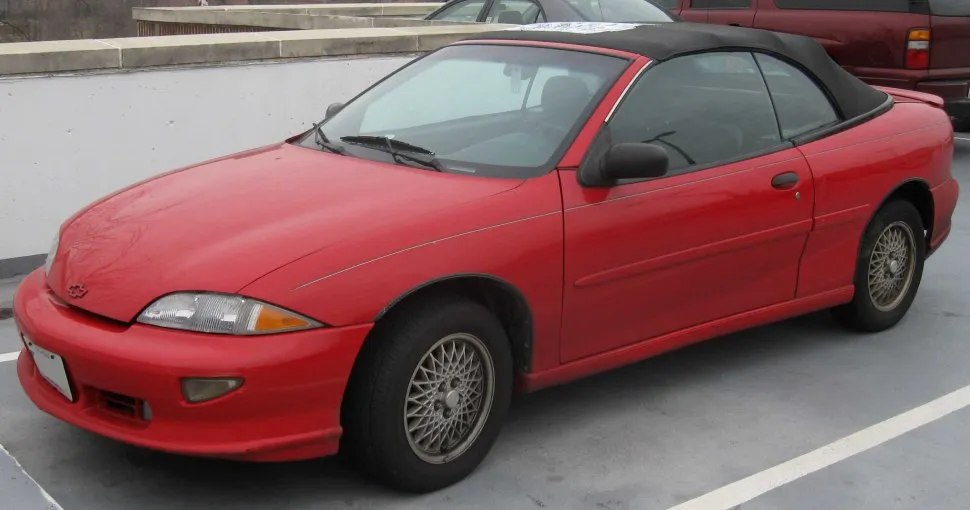
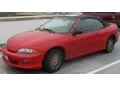
Chevrolet Cavalier Coupe III (J) 2.2 i (117 Hp)
Overall Rating
Chevrolet Cavalier:
The Chevrolet Cavalier is a line of compact cars produced by Chevrolet. Serving as the replacement of the Chevrolet Monza, the Cavalier was the second Chevrolet model line to adopt front-wheel drive. Three versions of the Cavalier have been sold, including three generations sold in North America from model years 1982 to 2005, a version produced by SAIC-GM for China from 2016 to 2021, and a SAIC-GM version produced for Mexico since the 2019 model year.
The Cavalier was among the inaugural vehicles of the GM J platform. One of the first "world cars" of General Motors, the J platform was developed for use by each North American GM division , alongside international models for Opel, Vauxhall, and Holden. Though sharing chassis underpinnings, J-body cars from Europe and Australia used slightly different body designs and different powertrains; in Europe, the Vauxhall Cavalier and Opel Ascona were marketed as mid-size cars. Initially a divisional counterpart of the Buick Skyhawk, Cadillac Cimarron, Oldsmobile Firenza, and Pontiac J2000, the Cavalier was primarily marketed alongside the Pontiac Sunbird....(Read more on Wikipedia)
Coupe III (J) Overview:
Chevrolet Cavalier (Coupe III (J)). With 183 Nm of torque, it offers ample pulling power. It has moderate fuel consumption (~10.2 l/100km). Weighing only 1190 kg, it’s quite light. Front‑wheel drive delivers efficiency and easy handling. Acceleration is relatively slow (0–100 km/h in 10 s). The top speed reaches 170 km/h. A two-door car with a fixed roof, known for its sporty design and dynamic performance. Seating for 5 makes it ideal for daily use.
2.2 i (117 Hp) Verdict:

Performance Verdict
The base engine, offering adequate power for basic transportation but feeling somewhat underpowered for spirited driving.
Fuel Economy
Specific data is missing, but likely offers reasonable economy for its output, though possibly less refined than the EcoTec.
Pros and Cons:
Pros:
- • Affordable purchase price and low running costs
- • Simple, easy-to-maintain mechanics
- • Decent fuel economy, especially with EcoTec engines
- • Practical for daily commuting
- • Available coupe styling for a sportier look
Cons:
- • Interior quality and materials are basic
- • Bland styling for some tastes
- • Not particularly refined or quiet at highway speeds
- • Limited advanced safety features by modern standards
- • Resale value can be lower compared to Japanese rivals
Specifications:
Specifications are compared to those of the previous generation(II: 1988 - 1994).
| General: | |
|---|---|
| Brand: | Chevrolet |
| Model: | Cavalier |
| Generation: | Coupe III (J) |
| Modification (Engine): | 2.2 i (117 Hp) |
| Start of production: | 1995 |
| End of production: | 2001 |
| Powertrain Architecture: | Internal Combustion engine |
| Body type: | Coupe |
| Seats: | 5 |
| Doors: | 2 |
| Engine: | |
|---|---|
| Power: | 117 Hp @ 5000 rpm. Same horsepower |
| Power per litre: | 53.4 Hp/l [worst than previous generation] |
| Torque: | 183 Nm @ 3600 rpm. |
| Engine Model/Code: | L61 More details about the engine L61 |
| Engine displacement: | 2190 |
| Number of cylinders: | 4 |
| Engine configuration: | Inline |
| Number of valves per cylinder: | 2 |
| Fuel injection system: | Multi-port manifold injection |
| Engine aspiration: | Naturally aspirated engine |
| Engine oil capacity: | 4.8 l |
| Coolant: | 9.8 l |
| Engine layout: | Front, Transverse |
| Cylinder Bore: | 89 mm |
| Piston Stroke: | 88 mm |
| Compression ratio: | 9:1 |
| Performance: | |
|---|---|
| Fuel Type: | Petrol (Gasoline) |
| Fuel consumption (economy) - urban: | 10.2 l/100 km |
| Fuel consumption (economy) - extra urban: | 7.6 l/100 km |
| Acceleration 0 - 100 km/h: | 10 sec |
| Acceleration 0 - 62 mph: | 10 sec |
| Maximum speed: | 170 km/h |
| Weight-to-power ratio: | 10.2 kg/Hp, 98.3 Hp/tonne |
| Weight-to-torque ratio: | 6.5 kg/Nm, 153.8 Nm/tonne |
| Acceleration 0 - 60 mph: | 9.5 sec |
| Space: | |
|---|---|
| Kerb Weight: | 1190 |
| Trunk (boot) space - maximum: | 1000 l |
| Trunk (boot) space - minimum: | 380 l |
| Fuel tank capacity: | 57 l |
| Size: | |
|---|---|
| Length: | 4590 mm |
| Width: | 1750 mm |
| Height: | 1350 mm |
| Wheelbase: | 2460 mm |
| Front track: | 1460 mm |
| Rear (Back) track: | 1430 mm |
| Powertrain: | |
|---|---|
| Drivetrain Architecture | The Internal combustion engine (ICE) drives the front wheels of the vehicle. |
| Drive wheel | Front wheel drive |
| Number of gears | 3 |
| Transmission type | Automatic |
| Front brakes | Ventilated discs [Best for performance and cooling.] |
| Rear brakes | Drum [bad for performance and cooling.] |
| Assisting systems | ABS (Anti-lock braking system) |
| Steering type | Steering rack and pinion |
| Power steering | Hydraulic Steering |
| Tires size | 195/65 R14 |
| Front suspension | Wishbone |
| Rear suspension | Trailing arm |












Driven it? Loved it? Hated it? Share your honest review!