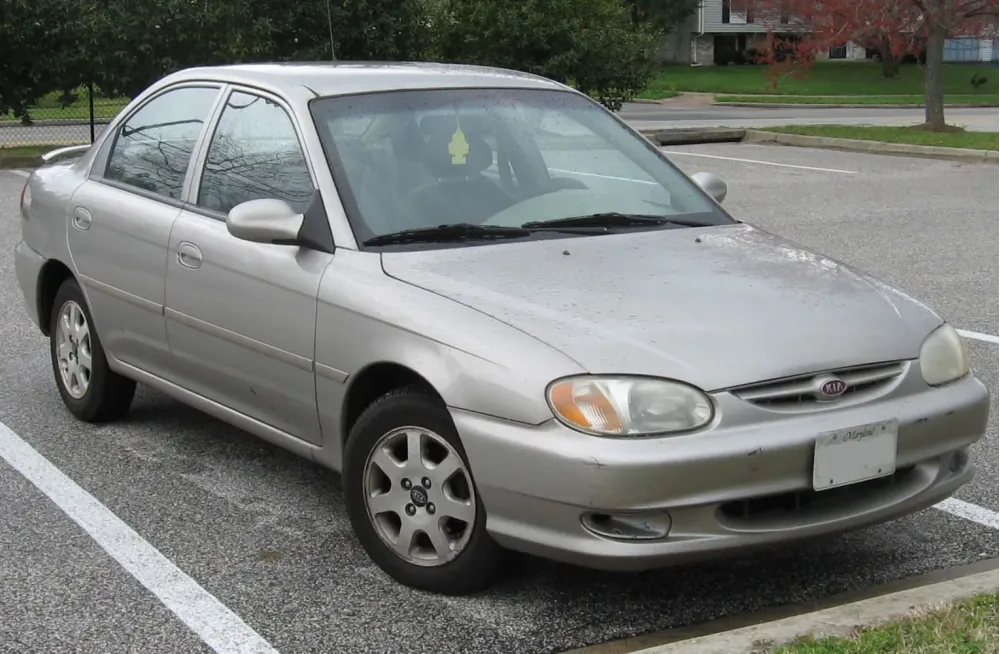
Click on image to view the full photo gallery
Kia Sephia II 1.5 i (80 Hp)
Overall Rating
Kia Sephia:
The Kia Sephia is a compact car that was manufactured by the South Korean automaker Kia Motors from September 1992 to 2003.
The first generation Sephia was badged Kia Mentor in some markets, and as the Timor S515/S516 in Indonesia. This convention continued on with the second generation version, which was also badged Kia Shuma and Kia Spectra.
The first-generation Kia Sephia is the first car that was actually designed by Kia with their own chassis. Engines available were the B-series engines, with the 1. 5-liter rated at 59 kilowatts , the 1. 6-liter 78-kilowatt , and the 1. 8-liter BP engine at 91-kilowatt from 1994. The car was presented in September 1992 to replace the aging Capital, which was rapidly losing market share. The Sephia proved quite successful, selling over 100,000 in its first full year in the home market. A total of 472,920 Sephias were sold over the life of the original Sephia....(Read more on Wikipedia)
II Overview:
Kia Sephia (II). With 120 Nm of torque, it offers ample pulling power. It has moderate fuel consumption (~11 l/100km). Weighing only 1055 kg, it’s quite light. Front‑wheel drive delivers efficiency and easy handling. Acceleration is relatively slow (0–100 km/h in 13.8 s). The top speed reaches 170 km/h. A four-door car with a separate trunk, ideal for families and daily commuting. Seating for 5 makes it ideal for daily use.
The Kia Sephia II was not tested by Euro NCAP. Safety features were basic for its era, typically including ABS as an assisting system.
1.5 i (80 Hp) Verdict:

Performance Verdict
The least powerful option, resulting in sluggish acceleration and limited highway overtaking capability.
Fuel Economy
Slightly better urban economy than the 88hp version, but may work harder on highways, impacting efficiency.
Pros and Cons:
Pros:
- • Affordable purchase price
- • Good fuel economy on some trims
- • Practical and spacious interior for its class
- • Simple and reliable mechanics
- • Low running costs
Cons:
- • Uninspired performance (especially base engines)
- • Basic interior quality and features
- • Lack of advanced safety systems
- • Dated design by the end of its production
- • Limited brand appeal compared to rivals
Specifications:
Specifications are compared to those of the previous generation(FA: 1996 - 1998).
| General: | |
|---|---|
| Brand: | Kia |
| Model: | Sephia |
| Generation: | II |
| Modification (Engine): | 1.5 i (80 Hp) |
| Start of production: | 1998 |
| End of production: | 2003 |
| Powertrain Architecture: | Internal Combustion engine |
| Body type: | Sedan |
| Seats: | 5 |
| Doors: | 4 |
| Engine: | |
|---|---|
| Power: | 80 Hp @ 5500 rpm. |
| Power per litre: | 53.4 Hp/l |
| Torque: | 120 Nm @ 2500 rpm. |
| Engine displacement: | 1498 |
| Number of cylinders: | 4 |
| Engine configuration: | Inline |
| Number of valves per cylinder: | 2 |
| Fuel injection system: | Multi-port manifold injection |
| Engine aspiration: | Naturally aspirated engine |
| Engine layout: | Front, Transverse |
| Cylinder Bore: | 78 mm mm |
| Piston Stroke: | 78.4 mm mm |
| Compression ratio: | 9.3:1 |
| Performance: | |
|---|---|
| Fuel Type: | Petrol (Gasoline) |
| Fuel consumption (economy) - urban: | 11 l/100 km |
| Fuel consumption (economy) - extra urban: | 6.1 l/100 km |
| Acceleration 0 - 100 km/h: | 13.8 sec |
| Acceleration 0 - 62 mph: | 13.8 sec |
| Maximum speed: | 170 km/h |
| Weight-to-power ratio: | 13.2 kg/Hp, 75.8 Hp/tonne |
| Weight-to-torque ratio: | 8.8 kg/Nm, 113.7 Nm/tonne |
| Acceleration 0 - 60 mph: | 13.1 sec |
| Space: | |
|---|---|
| Kerb Weight: | 1055 |
| Max. weight: | 1590 |
| Max load: | 535 |
| Trunk (boot) space - maximum: | 692 l |
| Trunk (boot) space - minimum: | 370 l |
| Fuel tank capacity: | 50 l |
| Size: | |
|---|---|
| Length: | 4427 mm mm [67mm more] |
| Width: | 1711 mm mm [16mm more] |
| Height: | 1415 mm mm [25mm more] |
| Wheelbase: | 2560 mm mm [60mm more] |
| Front track: | 1465 mm |
| Rear (Back) track: | 1455 mm |
| Powertrain: | |
|---|---|
| Drivetrain Architecture | The Internal combustion engine (ICE) drives the front wheels of the vehicle. |
| Drive wheel | Front wheel drive |
| Number of gears | 5 |
| Transmission type | Manual |
| Front brakes | Ventilated discs [Best for performance and cooling.] |
| Rear brakes | Drum [bad for performance and cooling.] |
| Assisting systems | ABS (Anti-lock braking system) |
| Steering type | Steering rack and pinion |
| Power steering | Hydraulic Steering |
| Tires size | 175/70 R13 |
| Front suspension | Spring Strut |
| Rear suspension | Spring Strut |


Better than its competitors? Tell us why the Kia Sephia stands out.