Maserati Sebring Series I (Tipo AM 101/S) 3.5 (235 Hp)
People\'s Opinion
N/A / 5
Maserati Sebring:
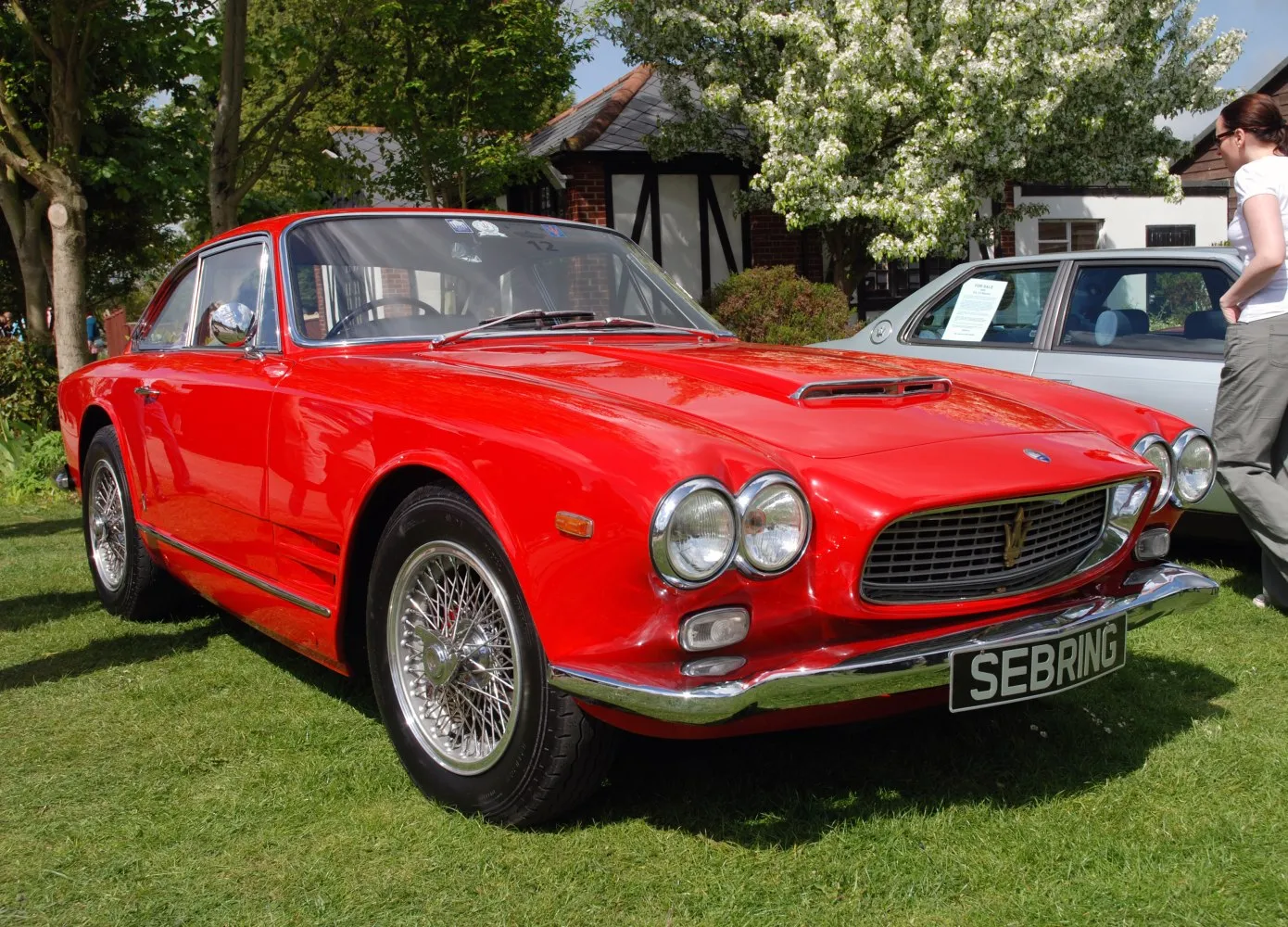
The Maserati Sebring was a two-door 2+2 coupé manufactured by Maserati from 1962 until 1968. Based on the Maserati 3500, the Sebring was aimed at the American Gran Turismo market and named after Maserati's 1957 racing victory at the 12 Hours of Sebring. A single two-seat spyder was built by Vignale in 1963 but did not enter production.
The Series I was shown at Salon International de l'Auto 1962 and again at the Salone dell'automobile di Torino in 1963. Employing all but the Maserati 3500's coachwork, it could reach 137 mph and 0–60 mph in 8. 5 seconds on 185x16 Pirelli Cinturato tyres. A Borg-Warner automatic transmission was available as an option, a first for Italian automobiles. When leaving the factory it originally fitted Pirelli Cinturato 205VR15 tyres. A total of 348 Series I Sebrings were built between 1962 and 1965. The engine was updated in 1963, gaining 15PS for a total of 235 PS. The 3700 engine first appeared in 1964, although only a handful of Series I cars were thus equipped....(Read more on Wikipedia)
Series I (Tipo AM 101/S) Overview:
Maserati Sebring (Series I (Tipo AM 101/S)). Rear‑wheel drive offers dynamic handling and sporty feedback. A luxury car designed for high-speed and long-distance driving with comfort. Seating for 4 makes it ideal for daily use.
Performance Verdict
Provides strong and smooth power delivery, offering a refined yet potent driving experience ideal for long-distance cruising.
Fuel Economy
Fuel economy is characteristic of a high-performance engine from the period, prioritizing power over efficiency.
Best Use Case:
Grand Touring / Highway
Pros and Cons:
Pros:
- • Elegant Italian styling
- • Powerful and sonorous inline-six engines
- • Luxurious interior for grand touring
- • Exclusive and rare classic car
- • Strong performance for its era
Cons:
- • High fuel consumption
- • Expensive to maintain and restore
- • Lack of modern safety features
- • Limited parts availability
- • Relatively high purchase price for a classic
Specifications:
| General: |
| Brand: | Maserati |
|---|
| Model: | Sebring |
|---|
| Generation: | Series I (Tipo AM 101/S) |
|---|
| Modification (Engine): | 3.5 (235 Hp) |
|---|
| Start of production: | 1962 |
|---|
| End of production: | 1965 |
|---|
| Powertrain Architecture: | Internal Combustion engine |
|---|
| Body type: | Grand Tourer |
|---|
| Seats: | 4 |
|---|
| Doors: | 2 |
|---|
| Engine: |
| Power: | 235 Hp @ 5500 rpm. |
|---|
| Power per litre: | 67.4 Hp/l |
|---|
| Engine Model/Code: | Tipo AM101, 101/10 |
|---|
| Engine displacement: | 3485 |
|---|
| Number of cylinders: | 6 |
|---|
| Engine configuration: | Inline |
|---|
| Number of valves per cylinder: | 4 |
|---|
| Fuel injection system: | Multi-port manifold injection |
|---|
| Engine aspiration: | Naturally aspirated engine |
|---|
| Valvetrain: | DOHC |
|---|
| Engine layout: | Front, Longitudinal |
|---|
| Cylinder Bore: | 86 mm mm |
|---|
| Piston Stroke: | 100 mm mm |
|---|
| Compression ratio: | 8.8:1 |
|---|
| Performance: |
| Fuel Type: | Petrol (Gasoline) |
|---|
| Fuel consumption (economy) - combined: | 14 l/100 km |
|---|
| Space: |
| Trunk (boot) space - minimum: | 340 l |
|---|
| Fuel tank capacity: | 70 l |
|---|
| Size: |
| Length: | 4470 mm mm |
|---|
| Width: | 1650 mm mm |
|---|
| Height: | 1300 mm mm |
|---|
| Wheelbase: | 2500 mm mm |
|---|
| Front track: | 1390 mm |
|---|
| Rear (Back) track: | 1380 mm |
|---|
| Powertrain: |
| Drivetrain Architecture | The Internal combustion engine (ICE) drives the rear wheels of the vehicle. |
|---|
| Drive wheel | Rear wheel drive |
|---|
| Number of gears | 5 |
|---|
| Transmission type | Manual |
|---|
| Front brakes | Disc |
|---|
| Rear brakes | Disc |
|---|
| Front suspension | Independent coil spring, Transverse stabilizer |
|---|
| Rear suspension | Transverse stabilizer, Leaf spring |
|---|











Better than its competitors? Tell us why the Maserati Sebring stands out.