
Click on image to view the full photo gallery
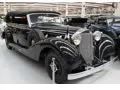
Mercedes-Benz W150 770 Cabriolet (W150) 7.7 (230 Hp)
Overall Rating
Mercedes-Benz W150:
The Mercedes-Benz 770, also known as the Großer Mercedes , was an ultra luxury car built by Mercedes-Benz from 1930 until 1944. The second model is best known from its use by high-ranking officials of Nazi Germany and their allies before and during World War II, including Adolf Hitler, Hermann Göring, Heinrich Himmler, Reinhard Heydrich, Ion Antonescu, Gustaf Mannerheim, and Benito Mussolini, many of which were captured in archival footage.
The 770 was introduced in 1930 as the successor to the Mercedes-Benz Typ 630, with the internal code W07. These high-priced cars were mainly used by governments as state vehicles. Reich President Paul von Hindenburg, Emperor Hirohito and Pope Pius XI were among the customers, and Adolf Hitler used a 770 from 1931 onwards. 117 W07-series cars were built until 1938....(Read more on Wikipedia)
770 Cabriolet (W150) Overview:
Mercedes-Benz W150 (770 Cabriolet (W150)). At around 3500 kg, it’s on the heavier side. Rear‑wheel drive offers dynamic handling and sporty feedback. The top speed reaches 170 km/h. A convertible car with a retractable roof, offering open-air driving experiences. With seating for 7, it’s perfect for larger families.
7.7 (230 Hp) Verdict:

Performance Verdict
The 7.7-liter M 150 supercharged inline-8 engine delivered an impressive 230 Hp, providing robust acceleration and a top speed of 170 km/h, making it one of the most powerful and fastest luxury cars of its era.
Fuel Economy
With a reported fuel consumption of 30 l/100 km, the 7.7-liter engine was exceptionally thirsty, reflecting the pre-war focus on power and luxury over fuel efficiency.
Pros and Cons:
Pros:
- • Exceptional power and performance for its era (230 Hp supercharged engine)
- • Unrivaled luxury and craftsmanship
- • Significant historical importance and rarity
- • Robust build quality and engineering
- • High top speed (170 km/h) for a pre-war vehicle
Cons:
- • Extremely high fuel consumption (30 l/100 km)
- • Lack of modern safety features
- • Very large and heavy, challenging to maneuver in tight spaces
- • High maintenance costs and scarcity of parts
- • Limited practicality due to size and historical nature
Specifications:
| General: | |
|---|---|
| Brand: | Mercedes-Benz |
| Model: | W150 |
| Generation: | 770 Cabriolet (W150) |
| Modification (Engine): | 7.7 (230 Hp) |
| Start of production: | 1938 |
| End of production: | 1943 |
| Powertrain Architecture: | Internal Combustion engine |
| Body type: | Cabriolet |
| Seats: | 7 |
| Doors: | 4 |
| Engine: | |
|---|---|
| Power: | 230 Hp @ 3200 rpm. |
| Power per litre: | 30 Hp/l |
| Engine Model/Code: | M 150 |
| Engine displacement: | 7655 |
| Number of cylinders: | 8 |
| Engine configuration: | Inline |
| Number of valves per cylinder: | 2 |
| Fuel injection system: | Carburettor |
| Engine aspiration: | Supercharger |
| Valvetrain: | OHV |
| Engine layout: | Front, Longitudinal |
| Cylinder Bore: | 95 mm mm |
| Piston Stroke: | 135 mm mm |
| Compression ratio: | 6.1:1 |
| Performance: | |
|---|---|
| Fuel Type: | Petrol (Gasoline) |
| Fuel consumption (economy) - combined: | 30 l/100 km |
| Maximum speed: | 170 km/h |
| Weight-to-power ratio: | 14.8 kg/Hp, 67.6 Hp/tonne |
| Space: | |
|---|---|
| Kerb Weight: | 3400-3600 |
| Max. weight: | 4200 |
| Max load: | 600-800 |
| Fuel tank capacity: | 195 l |
| Size: | |
|---|---|
| Length: | 6000 mm mm |
| Width: | 2070 mm mm |
| Height: | 1800 mm mm |
| Wheelbase: | 3880 mm mm |
| Front track: | 1600 mm |
| Rear (Back) track: | 1650 mm |
| Powertrain: | |
|---|---|
| Drivetrain Architecture | The Internal combustion engine (ICE) drives the rear wheels of the vehicle. |
| Drive wheel | Rear wheel drive |
| Number of gears | 5 |
| Transmission type | Manual |
| Front brakes | Drum |
| Rear brakes | Drum |
| Steering type | Worm-reduction unit |
| Front suspension | Coil spring, Double wishbone |
| Rear suspension | Rigid axle suspension, Coil spring |




Would you recommend the Mercedes-Benz W150 ? Tell us why or why not!