
Click on image to view the full photo gallery
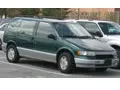
Mercury Villager I 3.0 V6 (151 Hp)
Overall Rating
Mercury Villager:
The Mercury Villager is a minivan that was marketed by Mercury from 1993 to 2002. Taking its name used by Mercury to denote its wood-trimmed station wagons, the Villager was developed in a joint venture between Ford and Nissan; the latter manufacturer marketed the line as the Nissan Quest. The first front-wheel drive van produced by Ford, the Mercury Villager was introduced between the Ford Aerostar and the Ford Windstar, competing against Chrysler minivans and the General Motors APV minivans.
Two generations of the model line were produced, with the Villager undergoing a full redesign for 1999. In a first for the minivan segment, the model line replaced a removable rear seat with a design that was repositionable. The Villager was the last Mercury developed with the lightbar grille used by the brand....(Read more on Wikipedia)
I Overview:
Mercury Villager (I). With 235 Nm of torque, it offers ample pulling power. With a weight of 1800 kg, it falls in the mid‑range. Front‑wheel drive delivers efficiency and easy handling. The top speed reaches 160 km/h. A spacious vehicle designed to transport passengers comfortably, often with sliding doors. With seating for 7, it’s perfect for larger families.
The Mercury Villager I was produced before Euro NCAP testing became widespread. Specific Euro NCAP ratings are not available for this generation, which was primarily marketed in North America.
3.0 V6 (151 Hp) Verdict:

Performance Verdict
The 151 Hp V6 engine provides adequate power for daily driving and family hauling, offering smooth and predictable acceleration suitable for a minivan, though not particularly spirited.
Fuel Economy
Fuel consumption of 12.2 l/100 km (approximately 19 MPG US) is typical for a V6 minivan of its era, but considered high by modern standards, especially in city driving.
Pros and Cons:
Pros:
- • Spacious and versatile interior with removable seats
- • Smooth and reliable V6 engine (VG30E)
- • Comfortable ride quality for long journeys
- • Good visibility from the driver's seat
- • Car-like handling for a minivan
Cons:
- • High fuel consumption compared to modern vehicles
- • Dated interior design by the end of its production run
- • Limited power for heavy loads or steep inclines
- • Rear drum brakes (less effective than discs)
- • No specific Euro NCAP safety rating available
Specifications:
| General: | |
|---|---|
| Brand: | Mercury |
| Model: | Villager |
| Generation: | I |
| Modification (Engine): | 3.0 V6 (151 Hp) |
| Start of production: | 1995 |
| End of production: | 1998 |
| Powertrain Architecture: | Internal Combustion engine |
| Body type: | Minivan |
| Seats: | 7 |
| Doors: | 4 |
| Engine: | |
|---|---|
| Power: | 151 Hp @ 4800 rpm. |
| Power per litre: | 51 Hp/l |
| Torque: | 235 Nm @ 4400 rpm. |
| Engine Model/Code: | VG30E |
| Engine displacement: | 2960 |
| Number of cylinders: | 6 |
| Engine configuration: | V-engine |
| Number of valves per cylinder: | 2 |
| Fuel injection system: | Multi-port manifold injection |
| Engine aspiration: | Naturally aspirated engine |
| Valvetrain: | OHC |
| Engine oil capacity: | 4 l |
| Coolant: | 10.1 l |
| Engine layout: | Front, Transverse |
| Cylinder Bore: | 87 mm mm |
| Piston Stroke: | 83 mm mm |
| Compression ratio: | 9:1 |
| Performance: | |
|---|---|
| Fuel Type: | Petrol (Gasoline) |
| Fuel consumption (economy) - combined: | 12.2 l/100 km |
| Maximum speed: | 160 km/h |
| Weight-to-power ratio: | 11.9 kg/Hp, 83.9 Hp/tonne |
| Weight-to-torque ratio: | 7.7 kg/Nm, 130.6 Nm/tonne |
| Space: | |
|---|---|
| Kerb Weight: | 1800 |
| Fuel tank capacity: | 76 l |
| Size: | |
|---|---|
| Length: | 4823 mm mm |
| Width: | 1872 mm mm |
| Height: | 1717 mm mm |
| Wheelbase: | 2850 mm mm |
| Front track: | 1610 mm |
| Rear (Back) track: | 1610 mm |
| Powertrain: | |
|---|---|
| Drivetrain Architecture | The Internal combustion engine (ICE) drives the front wheels of the vehicle. |
| Drive wheel | Front wheel drive |
| Number of gears | 4 |
| Transmission type | Automatic |
| Front brakes | Ventilated discs |
| Rear brakes | Drum |
| Assisting systems | ABS (Anti-lock braking system) |
| Steering type | Steering rack and pinion |
| Power steering | Hydraulic Steering |
| Tires size | 205/75 R15 |
| Front suspension | Wishbone |
| Rear suspension | Leaf spring |






Behind the wheel of the Mercury Villager. How does it handle on the road?