
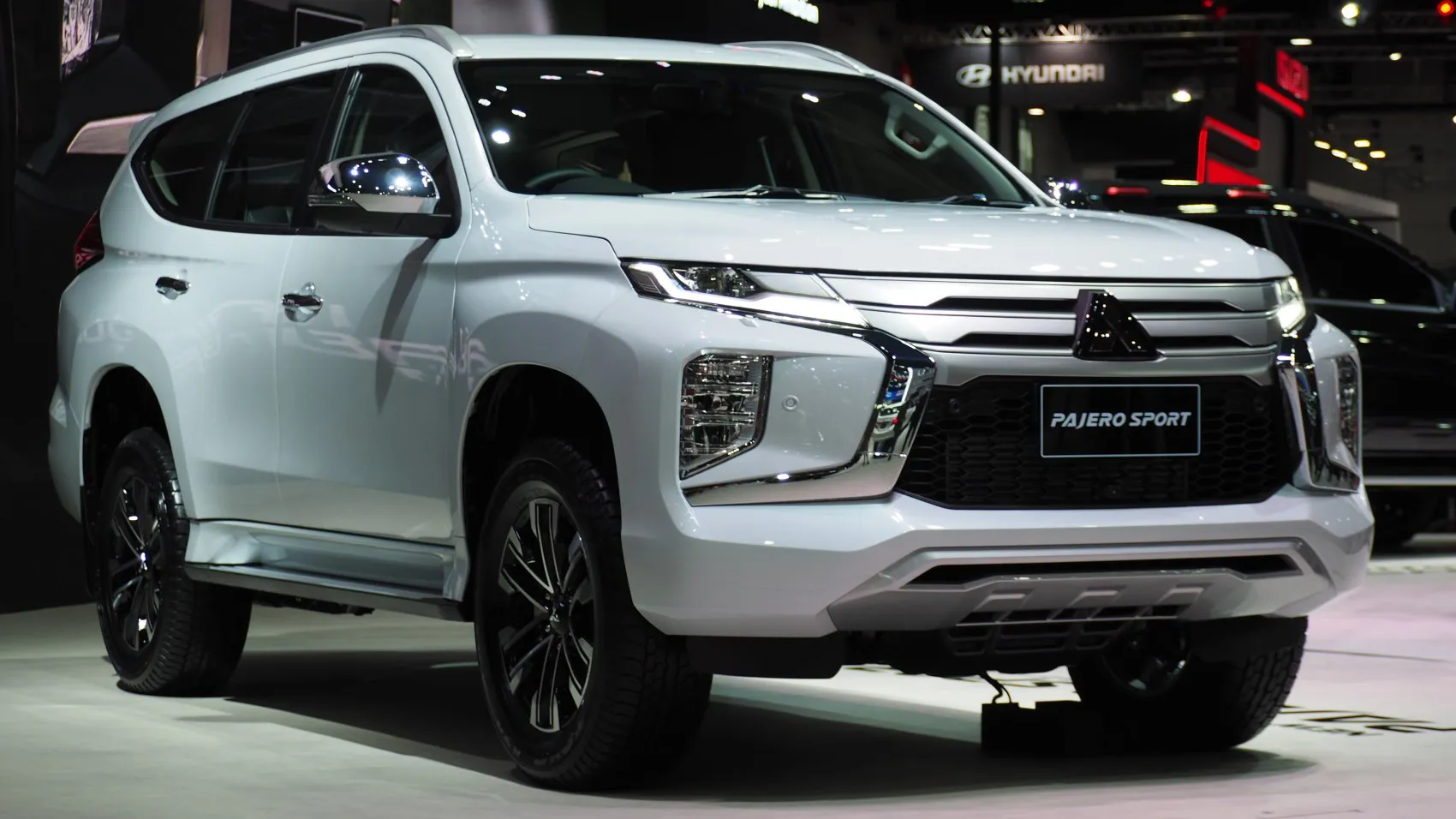
Click on image to view the full photo gallery
Mitsubishi Pajero Sport I (K90) 2.5 TD (115 Hp)
Overall Rating
Mitsubishi Pajero Sport:
The Mitsubishi Pajero Sport is a body-on-frame mid-size SUV produced by the Japanese manufacturer Mitsubishi Motors using the Pajero nameplate since 1996. Based on the Triton pickup truck, the Pajero Sport has spanned over three generations. It is unrelated to the full-size Pajero, which was also built on a Ladder frame chassis until 1999, switching to monocoque thereafter and was discontinued in 2021.
Mitsubishi has formerly used the Mitsubishi Challenger name for the vehicle in Japan and some international markets, but the name was dropped since the third generation in 2015 in favour of the Pajero Sport, Montero Sport, and Shogun Sport nameplates....(Read more on Wikipedia)
I (K90) Overview:
Mitsubishi Pajero Sport (I (K90)). With 240 Nm of torque, it offers ample pulling power. With a weight of 1920 kg, it falls in the mid‑range. All‑wheel drive provides excellent grip, ideal for off‑road use. Acceleration is relatively slow (0–100 km/h in 18.5 s). The top speed reaches 150 km/h. A rugged vehicle built to handle rough terrains and challenging driving conditions. Seating for 5 makes it ideal for daily use.
2.5 TD (115 Hp) Verdict:

Performance Verdict
Adequate for utility and off-road, but very sluggish on-road, especially for highway overtaking. Acceleration is notably slow.
Fuel Economy
High fuel consumption for its power output, reflecting older diesel technology and the vehicle's weight.
Pros and Cons:
Pros:
- • Excellent off-road capability with robust 4x4 system
- • Highly reliable and durable drivetrain, especially the diesel engines
- • Spacious interior and large boot capacity for cargo
- • Strong towing capacity for its class
- • Simple, proven mechanicals make it relatively easy to maintain
Cons:
- • Poor on-road performance and slow acceleration across most engine options
- • High fuel consumption, particularly for the V6 petrol variants
- • Dated interior design and materials compared to rivals
- • Rough ride quality on paved roads due to off-road suspension setup
- • Limited modern safety features and technology
Specifications:
Specifications are compared to those of the previous generation(I (K90): 1998 - 2004).
| General: | |
|---|---|
| Brand: | Mitsubishi |
| Model: | Pajero Sport |
| Generation: | I (K90) |
| Modification (Engine): | 2.5 TD (115 Hp) |
| Start of production: | 2000 |
| End of production: | 2008 |
| Powertrain Architecture: | Internal Combustion engine |
| Body type: | Off-road vehicle |
| Seats: | 5 |
| Doors: | 5 |
| Engine: | |
|---|---|
| Power: | 115 Hp @ 4000 rpm. |
| Power per litre: | 46.4 Hp/l |
| Torque: | 240 Nm @ 2000 rpm. |
| Engine displacement: | 2477 |
| Number of cylinders: | 4 |
| Engine configuration: | Inline |
| Number of valves per cylinder: | 4 |
| Fuel injection system: | Precombustion chamber injection |
| Engine aspiration: | Turbocharger |
| Valvetrain: | OHC |
| Engine layout: | Front, Longitudinal |
| Cylinder Bore: | 91.1 mm mm |
| Piston Stroke: | 95 mm mm |
| Compression ratio: | 21:1 |
| Performance: | |
|---|---|
| Fuel Type: | Diesel |
| Fuel consumption (economy) - urban: | 13.1 l/100 km |
| Fuel consumption (economy) - extra urban: | 9 l/100 km |
| Acceleration 0 - 100 km/h: | 18.5 sec |
| Acceleration 0 - 62 mph: | 18.5 sec |
| Maximum speed: | 150 km/h |
| Weight-to-power ratio: | 16.7 kg/Hp, 59.9 Hp/tonne |
| Weight-to-torque ratio: | 8 kg/Nm, 125 Nm/tonne |
| Acceleration 0 - 60 mph: | 17.6 sec |
| Space: | |
|---|---|
| Kerb Weight: | 1920 |
| Max. weight: | 2510 |
| Max load: | 590 |
| Trunk (boot) space - maximum: | 1720 l |
| Trunk (boot) space - minimum: | 500 l |
| Fuel tank capacity: | 74 l |
| Size: | |
|---|---|
| Length: | 4610 mm mm [Same length.] |
| Width: | 1775 mm mm [Same width.] |
| Height: | 1735 mm mm [Same height.] |
| Wheelbase: | 2725 mm mm [Same wheelbase.] |
| Front track: | 1465 mm |
| Rear (Back) track: | 1480 mm |
| Powertrain: | |
|---|---|
| Drive wheel | All wheel drive (4x4) |
| Number of gears | 5 |
| Transmission type | Manual |
| Front brakes | Disc |
| Rear brakes | Disc |
| Assisting systems | ABS (Anti-lock braking system) |
| Power steering | Hydraulic Steering |
| Tires size | 245/70 R16 |
| Front suspension | Torsion |
| Rear suspension | Coil spring |









Fuel, speed, and comfort: How does the Mitsubishi Pajero Sport rank in your book?