Moskvich 2137 Kombi 2137 Combi 1.5 (75 Hp)
People\'s Opinion
N/A / 5
Moskvich 2137 Kombi:
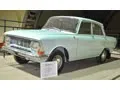
The Moskvitch 412 is a small family car produced by Soviet/Russian manufacturer MZMA/AZLK in Moscow from 1967 to 1975, and by IZh in Izhevsk from 1967 to 1982. It was a more powerful and prestigious version of the M-408 model, offering more features for a higher price.
The Moskvitch 412 derived from the Moskvitch 408, differing in more powerful 1. 5 engine. The earliest engines for the 412 were built in 1964. The Moskvitch 412 had a slanted inline-four engine with a block, head, and inlet manifold cast in aluminium alloy to keep the engine weight down, and a hemispherical combustion chamber. Steel cylinder liners were replaceable to enable easy repair of the engine instead of having to replace it entirely. Since it was of an OHC design, it was taller than the OHV MZMA-408 engine it replaced, which is why it was mounted at a slant. The UZAM-412 had a capacity of 1,478 cc c. c. and developed 75 horsepower. Its more powerful version, the Moskvitch-412-2V, had 100 h. p. and was installed on sports cars. The 1,478 cc UZAM-412 engine, with a light alloy block, was designed by Igor I. Okunev. According to some observers, it bore some similarities to the contemporary BMW M 115 motor used in the BMW 1500 model, although in other ways they are different from each other. The similarity between the two engines is purely superficial and limited only to the tilt angle of the cylinder block and between the valves and the gear of the overhead camshaft. The gearbox inherited from the M-408 was improved, with the gearbox ratios being revised to make better use of the increased power output. Until early 1969, M412 had the gear lever on the steering column, just like M-408, and did not have bucket seats, but a front bench, making M408 and 412 very hard to distinguish. From early 1969 on, because a new improved gearbox was installed in order to make a better use of the power and torque and to improve performances, M-412 had the gear lever mounted on the floor....(Read more on Wikipedia)
2137 Combi Overview:
Moskvich 2137 Kombi (2137 Combi). With 108 Nm of torque, it offers ample pulling power. It has moderate fuel consumption (~8.8 l/100km). Weighing only 1120 kg, it’s quite light. Rear‑wheel drive offers dynamic handling and sporty feedback. Acceleration is relatively slow (0–100 km/h in 24 s). The top speed reaches 135 km/h. A car with an extended rear cargo area, combining passenger comfort with increased storage. Seating for 5 makes it ideal for daily use.
Performance Verdict
The 1.5L (75 Hp) engine offers very modest performance, with slow acceleration (0-100 km/h in 24 seconds) and a low top speed, suitable only for basic utility and unhurried driving.
Fuel Economy
Fuel economy is rather poor for its power output, with an urban consumption of 8.8 l/100 km, reflecting older carburettor technology and less efficient design.
Best Use Case:
Rural / Utility / Light Haulage
Pros and Cons:
Pros:
- • Practical station wagon body with good cargo capacity
- • Simple, robust mechanicals for easy maintenance and repair
- • Affordable and utilitarian design for its era
- • Durable leaf spring rear suspension suitable for heavy loads
Cons:
- • Very poor acceleration and overall performance
- • High fuel consumption for its power output
- • Minimal safety features by any standard
- • Dated design and basic interior comfort
- • Limited availability of parts outside former Soviet bloc
Specifications:
| General: |
| Brand: | Moskvich |
|---|
| Model: | 2137 Kombi |
|---|
| Generation: | 2137 Combi |
|---|
| Modification (Engine): | 1.5 (75 Hp) |
|---|
| Start of production: | 1976 |
|---|
| End of production: | 1987 |
|---|
| Powertrain Architecture: | Internal Combustion engine |
|---|
| Body type: | Station wagon (estate) |
|---|
| Seats: | 5 |
|---|
| Doors: | 5 |
|---|
| Engine: |
| Power: | 75 Hp @ 5800 rpm. |
|---|
| Power per litre: | 50.7 Hp/l |
|---|
| Torque: | 108 Nm @ 3800 rpm. |
|---|
| Engine Model/Code: | UZA M-412 |
|---|
| Engine displacement: | 1479 |
|---|
| Number of cylinders: | 4 |
|---|
| Engine configuration: | Inline |
|---|
| Number of valves per cylinder: | 2 |
|---|
| Fuel injection system: | Carburettor |
|---|
| Engine aspiration: | Naturally aspirated engine |
|---|
| Engine layout: | Front, Longitudinal |
|---|
| Cylinder Bore: | 82 mm |
|---|
| Piston Stroke: | 70 mm |
|---|
| Compression ratio: | 8.8:1 |
|---|
| Performance: |
| Fuel Type: | Petrol (Gasoline) |
|---|
| Fuel consumption (economy) - urban: | 8.8 l/100 km |
|---|
| Acceleration 0 - 100 km/h: | 24 sec |
|---|
| Acceleration 0 - 62 mph: | 24 sec |
|---|
| Maximum speed: | 135 km/h |
|---|
| Weight-to-power ratio: | 14.9 kg/Hp, 67 Hp/tonne |
|---|
| Weight-to-torque ratio: | 10.4 kg/Nm, 96.4 Nm/tonne |
|---|
| Acceleration 0 - 60 mph: | 22.8 sec |
|---|
| Space: |
| Kerb Weight: | 1120 |
|---|
| Fuel tank capacity: | 46 l |
|---|
| Size: |
| Length: | 4210 mm |
|---|
| Width: | 1550 mm |
|---|
| Height: | 1270 mm |
|---|
| Wheelbase: | 2400 mm |
|---|
| Front track: | 1270 mm |
|---|
| Rear (Back) track: | 1270 mm |
|---|
| Powertrain: |
| Drivetrain Architecture | The Internal combustion engine (ICE) drives the rear wheels of the vehicle. |
|---|
| Drive wheel | Rear wheel drive |
|---|
| Number of gears | 5 |
|---|
| Transmission type | Manual |
|---|
| Front brakes | Disc |
|---|
| Rear brakes | Drum |
|---|
| Steering type | Worm-reduction unit |
|---|
| Tires size | 165/80 R13 |
|---|
| Front suspension | Coil spring |
|---|
| Rear suspension | Leaf spring |
|---|







What’s the best feature of the Moskvich 2137 Kombi? Tell us in the comments!