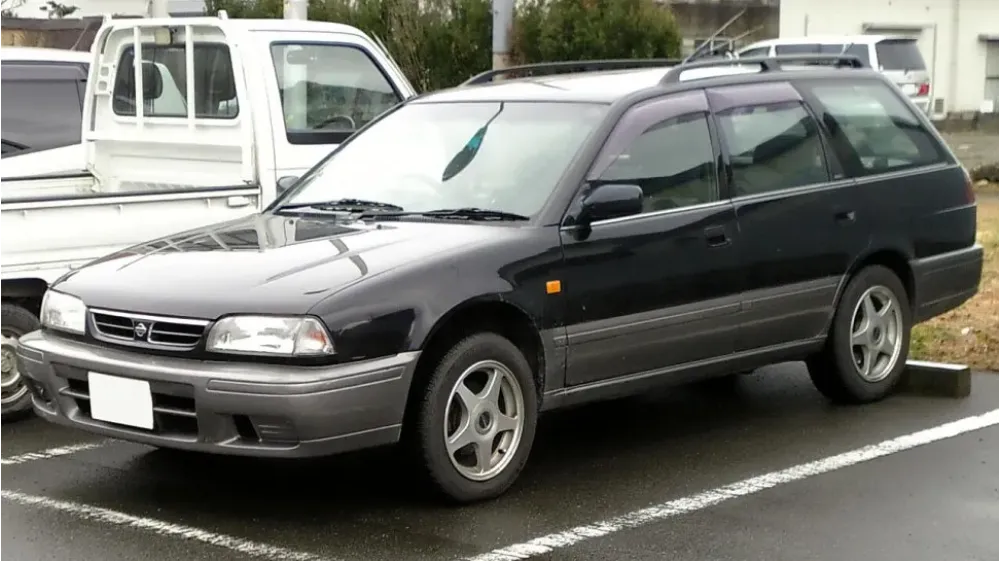
Click on image to view the full photo gallery
Nissan Avenir W10 1.8i 16V (110 Hp)
Overall Rating
Nissan Avenir:
The Nissan Avenir is a line of station wagons beginning production in May 1990 by Nissan of Japan, with the budget oriented delivery van starting out as the Avenir Cargo, then being renamed the Nissan Expert in 1999. The Avenir replaced the long-serving Nissan Bluebird wagon/delivery van and also the Skyline Van. It was a larger companion to the Nissan Wingroad/Nissan AD van. The 1999 Expert also assumed the load carrying duties of the discontinued Nissan Cedric and Gloria delivery vans. The Avenir appeared after the Subaru Legacy wagon, but before the competing Toyota Caldina wagon. The Avenir's appearance was not shared with another Nissan sedan, although it was sold as the estate version of the Primera in European markets....(Read more on Wikipedia)
W10 Overview:
Nissan Avenir (W10). With 150 Nm of torque, it offers ample pulling power. Weighing only 1150 kg, it’s quite light. Front‑wheel drive delivers efficiency and easy handling. A car with an extended rear cargo area, combining passenger comfort with increased storage. Seating for 5 makes it ideal for daily use.
The Nissan Avenir W10 was produced before Euro NCAP testing became widespread and standardized. As such, it was not officially tested. Safety features would be basic for its era, likely including standard seatbelts and potentially ABS on higher trims.
1.8i 16V (110 Hp) Verdict:

Performance Verdict
The manual gearbox significantly improves responsiveness and driver engagement compared to the automatic, making the 110 hp feel more lively.
Fuel Economy
Excellent fuel economy at 7.6 l/100 km for a wagon of its size, highlighting the efficiency benefits of a manual transmission.
Pros and Cons:
Pros:
- • Spacious and practical interior for families and cargo.
- • Generally reliable and durable, typical of Nissan vehicles of the era.
- • Wide range of engines, including efficient and performance-oriented options.
- • Comfortable ride quality, suitable for long journeys.
- • Available 4x4 models offer enhanced all-weather capability.
Cons:
- • Outdated safety features compared to modern vehicles.
- • Design is functional but lacks modern aesthetic appeal.
- • Some automatic transmissions can feel sluggish.
- • Fuel economy for 4x4 and higher-performance models can be high.
- • Limited availability outside of the Japanese domestic market.
Specifications:
| General: | |
|---|---|
| Brand: | Nissan |
| Model: | Avenir |
| Generation: | W10 |
| Modification (Engine): | 1.8i 16V (110 Hp) |
| Start of production: | 1991 |
| End of production: | 1998 |
| Powertrain Architecture: | Internal Combustion engine |
| Body type: | Station wagon (estate) |
| Seats: | 5 |
| Doors: | 5 |
| Engine: | |
|---|---|
| Power: | 110 Hp @ 6000 rpm. |
| Power per litre: | 59.8 Hp/l |
| Torque: | 150 Nm @ 4000 rpm. |
| Engine displacement: | 1838 |
| Number of cylinders: | 4 |
| Engine configuration: | Inline |
| Number of valves per cylinder: | 4 |
| Fuel injection system: | Multi-port manifold injection |
| Engine aspiration: | Naturally aspirated engine |
| Valvetrain: | DOHC |
| Engine layout: | Front, Transverse |
| Cylinder Bore: | 82.5 mm mm |
| Piston Stroke: | 86 mm mm |
| Compression ratio: | 9.5:1 |
| Performance: | |
|---|---|
| Fuel Type: | Petrol (Gasoline) |
| Fuel consumption (economy) - combined: | 7.6 l/100 km |
| Weight-to-power ratio: | 10.5 kg/Hp, 95.7 Hp/tonne |
| Weight-to-torque ratio: | 7.7 kg/Nm, 130.4 Nm/tonne |
| Space: | |
|---|---|
| Kerb Weight: | 1150 |
| Fuel tank capacity: | 60 l |
| Size: | |
|---|---|
| Length: | 4460 mm mm |
| Width: | 1695 mm mm |
| Height: | 1490 mm mm |
| Wheelbase: | 2550 mm mm |
| Front track: | 1460 mm |
| Rear (Back) track: | 1460 mm |
| Ride height (ground clearance): | 150 mm |
| Powertrain: | |
|---|---|
| Drivetrain Architecture | The Internal combustion engine (ICE) drives the front wheels of the vehicle. |
| Drive wheel | Front wheel drive |
| Number of gears | 5 |
| Transmission type | Manual |
| Front brakes | Ventilated discs |
| Rear brakes | Drum |
| Assisting systems | ABS (Anti-lock braking system) |
| Steering type | Steering rack and pinion |
| Power steering | Hydraulic Steering |
| Front suspension | Spring Strut |
| Rear suspension | Coil spring |


Show off your Nissan Avenir knowledge – drop a review below!