
Click on image to view the full photo gallery
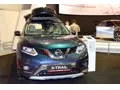
Nissan X-Trail III (T32) 1.6 dCi (130 Hp) 4x4 7 Seat
Overall Rating
Nissan X-Trail:
The Nissan X-Trail is a compact crossover SUV produced by the Japanese automaker Nissan since 2000, replacing the Rasheen and Terrano II. Since 2018, it is positioned between the Qashqai and the larger Murano.
Since the third-generation model, the X-Trail became the same vehicle as the North American market Rogue. For the first time, the X-Trail became available with three-row seating as an option. It also marked a departure in terms of design from a rugged boxy look to a more urban-oriented crossover SUV design. The fourth-generation model, launched for 2021, introduced an e-Power series hybrid powertrain option....(Read more on Wikipedia)
III (T32) Overview:
Nissan X-Trail (III (T32)). With 320 Nm of torque, it offers ample pulling power. It has moderate fuel consumption (~6.3 l/100km). With a weight of 1677 kg, it falls in the mid‑range. All‑wheel drive provides excellent grip, ideal for off‑road use. Acceleration is relatively slow (0–100 km/h in 11 s). The top speed reaches 186 km/h. A sport utility vehicle offering higher ground clearance and versatile cargo space. With seating for 7, it’s perfect for larger families.
1.6 dCi (130 Hp) 4x4 7 Seat Verdict:

Performance Verdict
Performance is adequate for general use, but can feel strained when fully loaded or tackling steep inclines, especially with 7 seats and 4x4.
Fuel Economy
Very good fuel economy for a 7-seat 4x4 SUV, making it a cost-effective choice for long journeys.
Pros and Cons:
Pros:
- • Spacious and practical interior with optional 7-seat configuration
- • Comfortable ride quality, well-suited for long journeys
- • Capable 4WD options for varied terrain and weather conditions
- • Strong and fuel-efficient diesel engines available
- • Good Euro NCAP safety rating for peace of mind
- • Generous boot space, especially in 5-seat configuration
Cons:
- • CVT gearbox can feel unengaging and noisy under hard acceleration
- • Some petrol engines can be thirsty, particularly the 2.0i and 2.5i
- • Interior materials, while durable, are not always premium-feeling
- • Limited true off-road prowess despite 4WD options
- • Third-row seats are best suited for children or short journeys
Specifications:
Specifications are compared to those of the previous generation(III (T32): 2014 - 2017).
| General: | |
|---|---|
| Brand: | Nissan |
| Model: | X-Trail |
| Generation: | III (T32) |
| Modification (Engine): | 1.6 dCi (130 Hp) 4x4 7 Seat |
| Start of production: | 2015 |
| End of production: | 2017 |
| Powertrain Architecture: | Internal Combustion engine |
| Body type: | SUV |
| Seats: | 7 |
| Doors: | 5 |
| Engine: | |
|---|---|
| Engine systems: | Start & Stop System |
| Power: | 130 Hp @ 4000 rpm. Same horsepower |
| Power per litre: | 81.4 Hp/l [Same length.] |
| Torque: | 320 Nm @ 1750 rpm. |
| Engine Model/Code: | R9M More details about the engine R9M |
| Engine displacement: | 1598 |
| Number of cylinders: | 4 |
| Engine configuration: | Inline |
| Number of valves per cylinder: | 4 |
| Fuel injection system: | Diesel Commonrail |
| Engine aspiration: | Turbocharger, Intercooler |
| Engine oil capacity: | 5.5 l |
| Coolant: | 7.9 l |
| Engine layout: | Front, Transverse |
| Cylinder Bore: | 80 mm mm |
| Piston Stroke: | 79.5 mm mm |
| Performance: | |
|---|---|
| Fuel Type: | Diesel |
| Fuel consumption (economy) - urban: | 6.2 - 6.3 l/100 km |
| Fuel consumption (economy) - extra urban: | 4.8 - 4.9 l/100 km |
| Fuel consumption (economy) - combined: | 5.3 - 5.4 l/100 km |
| Emission standard: | Euro 6 |
| Acceleration 0 - 100 km/h: | 11 sec |
| Acceleration 0 - 62 mph: | 11 sec |
| Maximum speed: | 186 km/h |
| Weight-to-power ratio: | 12.3 kg/Hp, 81 Hp/tonne |
| Weight-to-torque ratio: | 5 kg/Nm, 199.4 Nm/tonne |
| Acceleration 0 - 60 mph: | 10.5 sec |
| Space: | |
|---|---|
| Kerb Weight: | 1605-1749 |
| Max. weight: | 2320 |
| Max. roof load: | 100 kg |
| Max load: | 571-715 |
| Trunk (boot) space - maximum: | 1877 l |
| Trunk (boot) space - minimum: | 135 l |
| Permitted trailer load with brakes (12%): | 2000 kg |
| Fuel tank capacity: | 60 l |
| Permitted trailer load without brakes: | 750 kg |
| Permitted towbar download: | 100 kg |
| Size: | |
|---|---|
| Ramp-over (brakeover) angle: | 20° |
| Length: | 4640 mm mm [Same length.] |
| Width: | 1820 mm mm [Same width.] |
| Height: | 1715 mm mm [5mm more] |
| Wheelbase: | 2705 mm mm [Same wheelbase.] |
| Front track: | 1575-1585 mm |
| Rear (Back) track: | 1575-1585 mm |
| Ride height (ground clearance): | 210 mm |
| Minimum turning circle (turning diameter): | 11.2 m [above average] |
| Approach angle: | 18° |
| Departure angle: | 27° |
| Powertrain: | |
|---|---|
| Drivetrain Architecture | The Internal combustion engine (ICE) drives the front wheels permanently, and the rear wheels are driven through an electrically or mechanically operated clutch if necessary. |
| Drive wheel | All wheel drive (4x4) |
| Number of gears | 6 |
| Transmission type | Manual |
| Front brakes | Ventilated discs [Best for performance and cooling.] |
| Rear brakes | Disc [above average] |
| Assisting systems | ABS (Anti-lock braking system) |
| Steering type | Steering rack and pinion |
| Tires size | 225/65 R17; 225/55 R19 |
| Wheel rims size | 7.0J x 17; 7.0J x 19 |
| Front suspension | Independent type McPherson |
| Rear suspension | Independent multi-link suspension |












Would you recommend the Nissan X-Trail ? Tell us why or why not!