
Click on image to view the full photo gallery
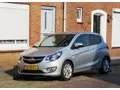
Opel Karl Rocks 1.0 (73 Hp)
Overall Rating
Opel Karl:
The Opel Karl is a city car with a hatchback manufactured by GM Korea and marketed by Opel as a rebadged and restyled variant of the fourth-generation Chevrolet Spark , replacing the Suzuki-sourced Agila in Opel's range. Named after Adam Opel's eldest son Carl, the city car was discontinued following the sale of Opel to PSA Group in 2019. General Motors marketed a rebadged variant in the United Kingdom as the Vauxhall Viva, resurrecting an old nameplate from 1963 to 1979.
The Karl is a rebadged and restyled variant of the fourth-generation Chevrolet Spark, manufactured in South Korea. With fuel consumption reaching 4. 3 L/100 km , the Karl's 1. 0 L three-cylinder direct injection engine making 55 kW is from the GM engine family. Dimensionally very similar to its predecessor, it is 115 mm lower, making it almost the same size as the more expensive three-door Opel Adam....(Read more on Wikipedia)
Rocks Overview:
Opel Karl (Rocks). With 95 Nm of torque, it offers ample pulling power. It has moderate fuel consumption (~6.2 l/100km). Weighing only 939 kg, it’s quite light. Front‑wheel drive delivers efficiency and easy handling. Acceleration is relatively slow (0–100 km/h in 14 s). The top speed reaches 168 km/h. A compact car with a rear door that swings upward to provide access to the cargo area. Seating for 5 makes it ideal for daily use.
The Opel Karl (tested as Vauxhall Viva) received a respectable 4-star Euro NCAP rating in 2015, indicating good overall safety performance for its segment, though some newer rivals might offer more advanced active safety features.
1.0 (73 Hp) Verdict:

Performance Verdict
The 1.0-liter naturally aspirated engine provides adequate power for city driving and light urban commutes. Its 73 Hp output and 14-second 0-100 km/h acceleration are modest, making it less suited for prolonged highway cruising or rapid overtakes.
Fuel Economy
With a combined fuel consumption of 5.2 l/100 km, this engine offers good fuel efficiency, particularly in urban settings. Its small displacement and lightweight design contribute to economical running costs, making it a budget-friendly option.
Pros and Cons:
Pros:
- • Excellent maneuverability and compact size for city driving.
- • Good fuel economy, especially in urban conditions.
- • Affordable purchase price and low running costs.
- • Practical interior and decent boot space for its class.
- • Slightly raised ride height and rugged styling of the Rocks trim.
Cons:
- • Modest engine performance, struggles on highways.
- • Basic interior materials and limited premium features.
- • Limited advanced safety features compared to newer rivals.
- • Small fuel tank capacity (32L) requires frequent refueling.
- • Noise levels can be high at higher speeds.
Specifications:
| General: | |
|---|---|
| Brand: | Opel |
| Model: | Karl |
| Generation: | Rocks |
| Modification (Engine): | 1.0 (73 Hp) |
| Start of production: | January, 2018 |
| End of production: | June, 2019 |
| Powertrain Architecture: | Internal Combustion engine |
| Body type: | Hatchback |
| Seats: | 5 |
| Doors: | 5 |
| Engine: | |
|---|---|
| Power: | 73 Hp @ 6500 rpm. |
| Power per litre: | 73.1 Hp/l |
| Torque: | 95 Nm @ 4500 rpm. |
| Engine Model/Code: | D10XE |
| Engine displacement: | 999 |
| Number of cylinders: | 3 |
| Engine configuration: | Inline |
| Number of valves per cylinder: | 4 |
| Fuel injection system: | Multi-port manifold injection |
| Engine aspiration: | Naturally aspirated engine |
| Engine oil capacity: | 3.5 l |
| Coolant: | 4.2 l |
| Engine layout: | Front, Transverse |
| Cylinder Bore: | 74 mm mm |
| Piston Stroke: | 77.4 mm mm |
| Compression ratio: | 10.5:1 |
| Performance: | |
|---|---|
| Fuel Type: | Petrol (Gasoline) |
| Fuel consumption (economy) - urban: | 6.2 l/100 km |
| Fuel consumption (economy) - extra urban: | 4.5 l/100 km |
| Fuel consumption (economy) - combined: | 5.2 l/100 km |
| Emission standard: | Euro 6d |
| Acceleration 0 - 100 km/h: | 14 sec |
| Acceleration 0 - 62 mph: | 14 sec |
| Maximum speed: | 168 km/h |
| Weight-to-power ratio: | 12.9 kg/Hp, 77.7 Hp/tonne |
| Weight-to-torque ratio: | 9.9 kg/Nm, 101.2 Nm/tonne |
| Acceleration 0 - 60 mph: | 13.3 sec |
| Space: | |
|---|---|
| Kerb Weight: | 939 |
| Max. weight: | 1353 |
| Max load: | 414 |
| Trunk (boot) space - maximum: | 1013 l |
| Trunk (boot) space - minimum: | 206 l |
| Fuel tank capacity: | 32 l |
| Size: | |
|---|---|
| Length: | 3676 mm mm |
| Width: | 1632 mm mm |
| Height: | 1532 mm mm |
| Wheelbase: | 2385 mm mm |
| Width with mirrors folded: | 1698 mm |
| Width including mirrors: | 1876 mm |
| Front track: | 1396 mm |
| Rear (Back) track: | 1404 mm |
| Minimum turning circle (turning diameter): | 10.6 m |
| Powertrain: | |
|---|---|
| Drivetrain Architecture | The Internal combustion engine (ICE) drives the front wheels of the vehicle. |
| Drive wheel | Front wheel drive |
| Number of gears | 5 |
| Transmission type | Manual |
| Front brakes | Ventilated discs |
| Rear brakes | Drum |
| Assisting systems | ABS (Anti-lock braking system) |
| Steering type | Steering rack and pinion |
| Power steering | Electric Steering |
| Tires size | 165/65 R14; 185/55 R15; 195/45 R16 |
| Wheel rims size | 14; 15; 16 |








Is the Opel Karl your dream ride or just a daily drive? Let's talk!