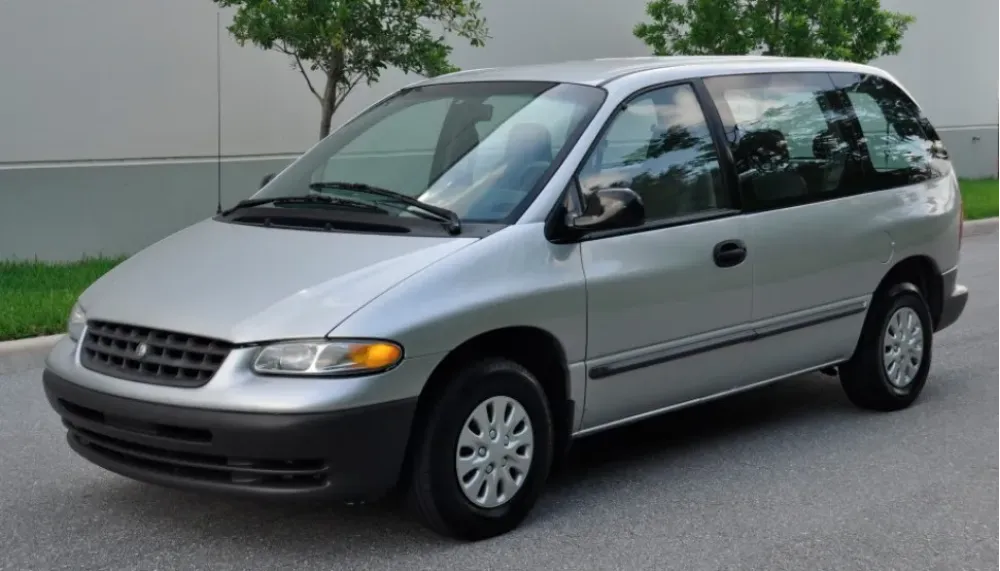
Click on image to view the full photo gallery
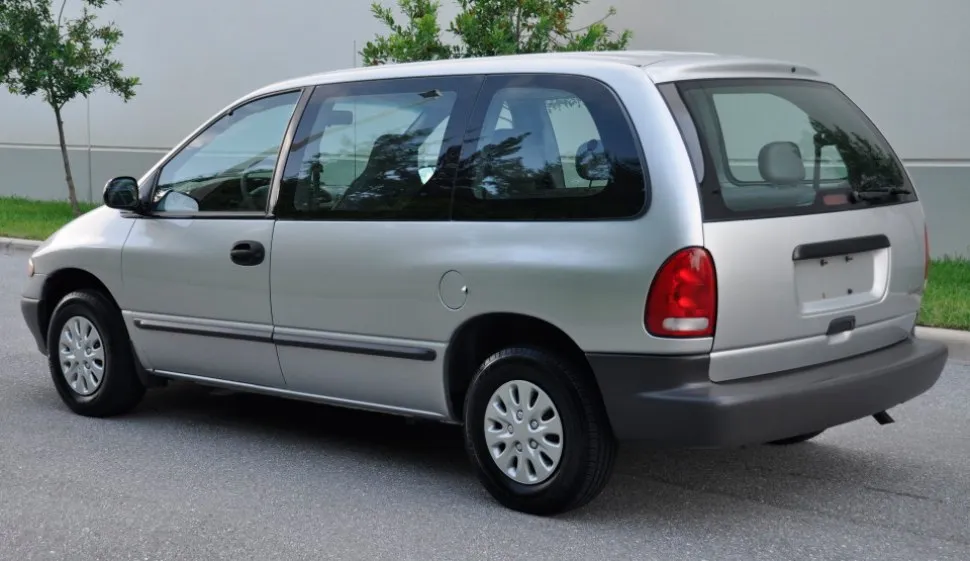
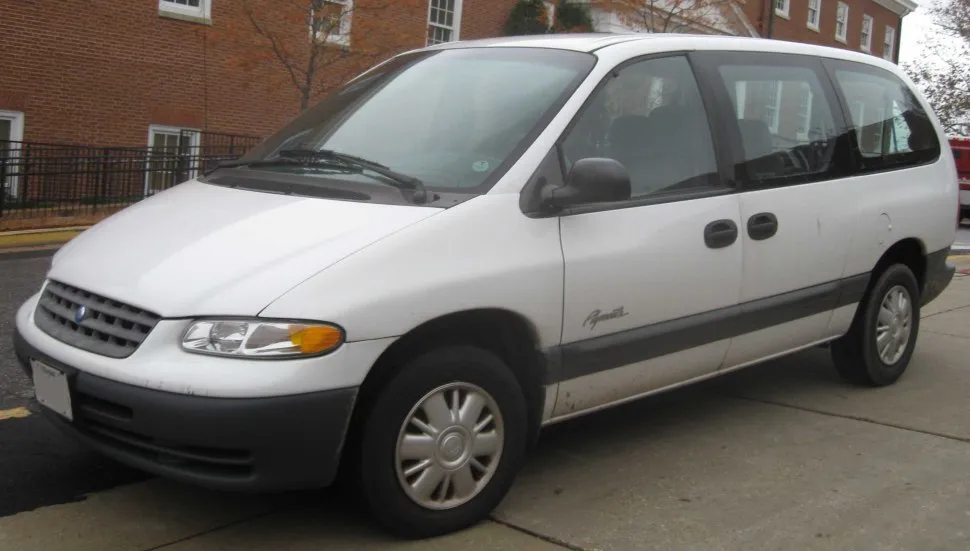
Plymouth Voyager II 2.4 i 16V (152 Hp)
Overall Rating
Plymouth Voyager:
Plymouth Voyager is a nameplate for a range of vans that were marketed by Plymouth from 1974 to 2000. One of the few light trucks marketed by the division, the Voyager was initially a full-size van, later becoming one of the first minivans successfully marketed in North America.
For its first generation, the Voyager was a full-size van, serving as the Plymouth counterpart of the Dodge Sportsman. For 1984, the Voyager was reintroduced as a minivan, becoming a divisional counterpart of the Dodge Caravan. For 1987, the model line was expanded with the extended-wheelbase Plymouth Grand Voyager and the luxury-trim Chrysler Town & Country for 1990. Three generations of the model line were sold until the closure of the Plymouth brand during the 2000 model year....(Read more on Wikipedia)
II Overview:
Plymouth Voyager (II). With 226 Nm of torque, it offers ample pulling power. It has moderate fuel consumption (~11.8 l/100km). With a weight of 1600 kg, it falls in the mid‑range. Front‑wheel drive delivers efficiency and easy handling. The top speed reaches 175 km/h. A spacious vehicle designed to transport passengers comfortably, often with sliding doors. Seating for 5 makes it ideal for daily use.
The Voyager II, as tested under its European Chrysler counterpart, received a low Euro NCAP rating, indicating significant concerns regarding adult occupant protection in frontal and side impacts for its time.
2.4 i 16V (152 Hp) Verdict:

Performance Verdict
Adequate for light loads, but the 152 Hp 2.4L engine paired with a 3-speed automatic transmission struggles with acceleration, especially when fully loaded or on inclines. Best suited for relaxed driving.
Fuel Economy
While theoretically the most economical option, the heavy minivan and inefficient 3-speed automatic mean real-world fuel economy is only marginally better than the V6s, especially in urban driving.
Pros and Cons:
Pros:
- • Spacious and versatile interior with flexible seating options
- • Comfortable ride quality, ideal for long family trips
- • Good visibility from the driver's seat
- • Reliable 3.3L V6 engine option
- • Affordable on the used market
Cons:
- • Dated 3-speed automatic transmission severely limits performance and economy
- • Low Euro NCAP safety rating for adult occupants
- • Interior materials can feel cheap and prone to wear
- • Average fuel economy across the lineup
- • Potential for transmission issues (especially with earlier models)
Specifications:
Specifications are compared to those of the previous generation(Voyager: 1990 - 1995).
| General: | |
|---|---|
| Brand: | Plymouth |
| Model: | Voyager |
| Generation: | II |
| Modification (Engine): | 2.4 i 16V (152 Hp) |
| Start of production: | 1996 |
| End of production: | 2000 |
| Powertrain Architecture: | Internal Combustion engine |
| Body type: | Minivan |
| Seats: | 5 |
| Doors: | 4 |
| Engine: | |
|---|---|
| Power: | 152 Hp @ 5200 rpm. Same horsepower |
| Power per litre: | 62.6 Hp/l [208mm more] |
| Torque: | 226 Nm @ 4000 rpm. |
| Engine displacement: | 2429 |
| Number of cylinders: | 4 |
| Engine configuration: | Inline |
| Number of valves per cylinder: | 4 |
| Fuel injection system: | Multi-port manifold injection |
| Engine aspiration: | Naturally aspirated engine |
| Valvetrain: | DOHC |
| Engine oil capacity: | 4.3 l |
| Coolant: | 9 l |
| Engine layout: | Front, Transverse |
| Cylinder Bore: | 87.5 mm mm |
| Piston Stroke: | 101 mm mm |
| Compression ratio: | 9.4:1 |
| Performance: | |
|---|---|
| Fuel Type: | Petrol (Gasoline) |
| Fuel consumption (economy) - urban: | 11.8 l/100 km |
| Fuel consumption (economy) - extra urban: | 9.4 l/100 km |
| Maximum speed: | 175 km/h |
| Weight-to-power ratio: | 10.5 kg/Hp, 95 Hp/tonne |
| Weight-to-torque ratio: | 7.1 kg/Nm, 141.3 Nm/tonne |
| Space: | |
|---|---|
| Kerb Weight: | 1600 |
| Trunk (boot) space - maximum: | 4140 l |
| Trunk (boot) space - minimum: | 450 l |
| Fuel tank capacity: | 75 l |
| Size: | |
|---|---|
| Length: | 4733 mm mm [208mm more] |
| Width: | 1920 mm mm [90mm more] |
| Height: | 1740 mm mm [67mm more] |
| Wheelbase: | 2878 mm mm [25mm more] |
| Front track: | 1600 mm |
| Rear (Back) track: | 1626 mm |
| Powertrain: | |
|---|---|
| Drivetrain Architecture | The Internal combustion engine (ICE) drives the front wheels of the vehicle. |
| Drive wheel | Front wheel drive |
| Number of gears | 3 |
| Transmission type | Automatic |
| Front brakes | Ventilated discs [Best for performance and cooling.] |
| Rear brakes | Drum [bad for performance and cooling.] |
| Assisting systems | ABS (Anti-lock braking system) |
| Steering type | Steering rack and pinion |
| Power steering | Hydraulic Steering |
| Tires size | 205/75 R14 S |
| Front suspension | Coil spring |
| Rear suspension | Leaf spring |




Driven it? Loved it? Hated it? Share your honest review!