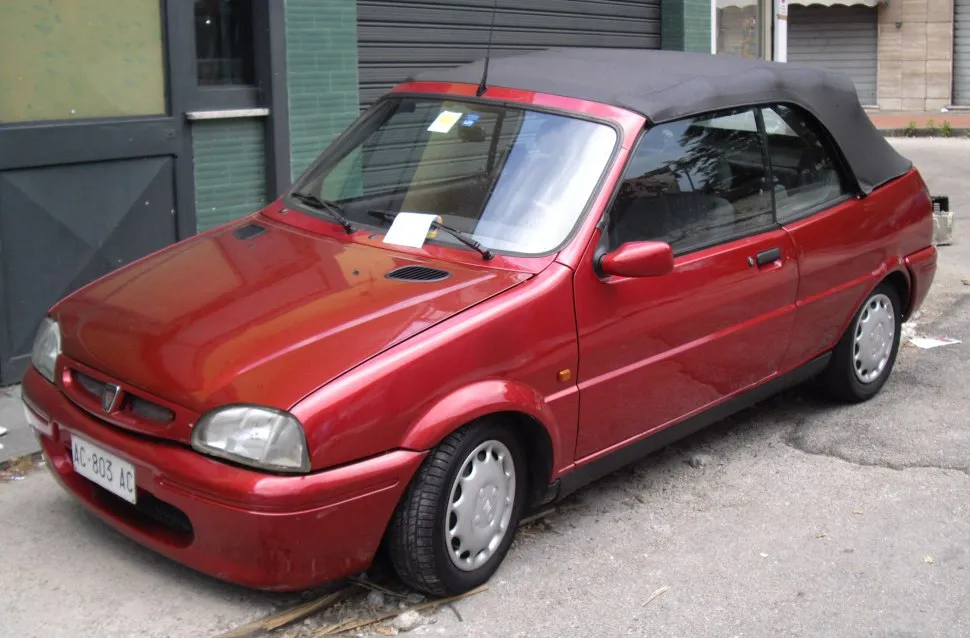
Rover 100 METRO) (XP 111 L (60 Hp)
People\'s Opinion
N/A / 5
Rover 100:
The name Rover 100 may refer to one of two different British motor vehicles:....(Read more on Wikipedia)
METRO) (XP Overview:
Rover 100 (METRO) (XP). With 90 Nm of torque, it offers ample pulling power. It has moderate fuel consumption (~7.1 l/100km). Weighing only 840 kg, it’s quite light. Front‑wheel drive delivers efficiency and easy handling. Acceleration is relatively slow (0–100 km/h in 14.8 s). The top speed reaches 155 km/h. A compact car with a rear door that swings upward to provide access to the cargo area. Seating for 5 makes it ideal for daily use.
Performance Verdict
A modest performer, suitable for city driving but struggles on highways or with heavy loads.
Fuel Economy
Offers decent fuel economy for its era, making it a cost-effective choice for daily commutes.
Best Use Case:
City / Urban Commuting
Pros and Cons:
Pros:
- • Compact and agile for city driving
- • Economical base engines
- • Lively performance from GTI variants
- • Low running costs (for base models)
Cons:
- • Very poor Euro NCAP safety rating
- • Known reliability issues, particularly with K-series head gaskets
- • Dated interior and features
- • Limited space for rear passengers and luggage
- • Unrefined at higher speeds
Specifications:
| General: |
| Brand: | Rover |
|---|
| Model: | 100 |
|---|
| Generation: | METRO) (XP |
|---|
| Modification (Engine): | 111 L (60 Hp) |
|---|
| Start of production: | 1990 |
|---|
| End of production: | 1998 |
|---|
| Powertrain Architecture: | Internal Combustion engine |
|---|
| Body type: | Hatchback |
|---|
| Seats: | 5 |
|---|
| Doors: | 3-5 |
|---|
| Engine: |
| Power: | 60 Hp @ 5900 rpm. |
|---|
| Power per litre: | 53.6 Hp/l |
|---|
| Torque: | 90 Nm @ 3500 rpm. |
|---|
| Engine Model/Code: | K8 |
|---|
| Engine displacement: | 1119 |
|---|
| Number of cylinders: | 4 |
|---|
| Engine configuration: | Inline |
|---|
| Number of valves per cylinder: | 2 |
|---|
| Fuel injection system: | Single-point injection |
|---|
| Engine aspiration: | Naturally aspirated engine |
|---|
| Valvetrain: | OHC |
|---|
| Engine oil capacity: | 4.5 l |
|---|
| Coolant: | 4.5 l |
|---|
| Engine layout: | Front, Transverse |
|---|
| Cylinder Bore: | 75 mm |
|---|
| Piston Stroke: | 63.2 mm |
|---|
| Compression ratio: | 9.8:1 |
|---|
| Performance: |
| Fuel Type: | Petrol (Gasoline) |
|---|
| Fuel consumption (economy) - urban: | 7.1 l/100 km |
|---|
| Fuel consumption (economy) - extra urban: | 4.5 l/100 km |
|---|
| Fuel consumption (economy) - combined: | 6.1 l/100 km |
|---|
| Acceleration 0 - 100 km/h: | 14.8 sec |
|---|
| Acceleration 0 - 62 mph: | 14.8 sec |
|---|
| Maximum speed: | 155 km/h |
|---|
| Weight-to-power ratio: | 14 kg/Hp, 71.4 Hp/tonne |
|---|
| Weight-to-torque ratio: | 9.3 kg/Nm, 107.1 Nm/tonne |
|---|
| Acceleration 0 - 60 mph: | 14.1 sec |
|---|
| Space: |
| Kerb Weight: | 840 |
|---|
| Max. weight: | 1290 |
|---|
| Max load: | 450 |
|---|
| Trunk (boot) space - maximum: | 552 l |
|---|
| Trunk (boot) space - minimum: | 229 l |
|---|
| Fuel tank capacity: | 35 l |
|---|
| Size: |
| Length: | 3521 mm |
|---|
| Width: | 1550 mm |
|---|
| Height: | 1377 mm |
|---|
| Wheelbase: | 2269 mm |
|---|
| Front track: | 1348 mm |
|---|
| Rear (Back) track: | 1297 mm |
|---|
| Powertrain: |
| Drivetrain Architecture | The Internal combustion engine (ICE) drives the front wheels of the vehicle. |
|---|
| Drive wheel | Front wheel drive |
|---|
| Number of gears | 5 |
|---|
| Transmission type | Manual |
|---|
| Front brakes | Disc |
|---|
| Rear brakes | Drum |
|---|
| Assisting systems | ABS (Anti-lock braking system) |
|---|
| Steering type | Steering rack and pinion |
|---|
| Tires size | 155/65 R13 |
|---|
| Front suspension | Wishbone |
|---|
| Rear suspension | Trailing arm |
|---|






If you could change one thing about the Rover 100, what would it be?