Click on image to view the full photo gallery
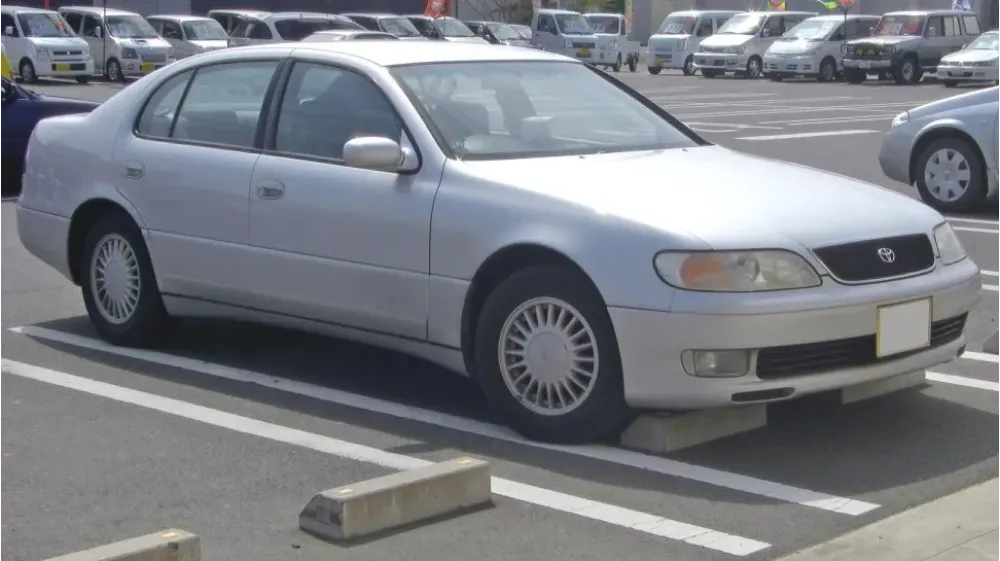
Toyota Aristo S14 3.0 i 24V Turbo (330 Hp)
Overall Rating
Toyota Aristo:
The Lexus GS is an executive car manufactured and marketed by Lexus across four generations — launched in 1991 as the Toyota Aristo in Japan and as the Lexus GS for markets outside the Japanese market beginning in February 1993. It continued with the Toyota Aristo name for the Japanese market until January 2005.
Lexus marketed the GS as a performance sedan competing in the mid-luxury class, between its compact executive IS and large/flagship LS. The GS shared its chassis with one of Toyota's longest-running nameplates, the Toyota Crown premium sedans until 2011....(Read more on Wikipedia)
S14 Overview:
Toyota Aristo (S14). With 440 Nm of torque, it offers ample pulling power. With a weight of 1680 kg, it falls in the mid‑range. Rear‑wheel drive offers dynamic handling and sporty feedback. A four-door car with a separate trunk, ideal for families and daily commuting. Seating for 5 makes it ideal for daily use.
The Toyota Aristo S14 was produced before Euro NCAP testing became standard. As a vehicle from the early 1990s, its safety features are typical for its era, lacking modern active safety systems and advanced crash structures.
3.0 i 24V Turbo (330 Hp) Verdict:

Performance Verdict
Powered by the legendary 2JZ-GTE, this engine offers immense power, exceptional smoothness, and incredible tuning potential, making it a true performance icon. Acceleration is thrilling for a luxury sedan.
Fuel Economy
Despite its high power output, the reported 9.6 l/100 km (combined) is respectable, though real-world aggressive driving will naturally see higher consumption. It's a fair trade-off for the performance.
Pros and Cons:
Pros:
- • Legendary 2JZ engines (both GTE and GE) known for reliability and durability
- • Exceptional performance, especially from the 2JZ-GTE turbo variant
- • High level of comfort and refinement for a luxury sedan of its era
- • Robust build quality and strong chassis
- • Significant tuning potential for the turbocharged model
Cons:
- • Fuel economy can be high, particularly for the turbo model under spirited driving
- • Interior design and technology are dated by modern standards
- • Parts availability for specific JDM components can be challenging outside Japan
- • Older safety technology compared to contemporary vehicles
- • Automatic transmission options are not as engaging as modern gearboxes
Specifications:
| General: | |
|---|---|
| Brand: | Toyota |
| Model: | Aristo |
| Generation: | S14 |
| Modification (Engine): | 3.0 i 24V Turbo (330 Hp) |
| Start of production: | 1991 |
| End of production: | 1997 |
| Powertrain Architecture: | Internal Combustion engine |
| Body type: | Sedan |
| Seats: | 5 |
| Doors: | 4 |
| Engine: | |
|---|---|
| Power: | 330 Hp @ 5600 rpm. |
| Power per litre: | 110.1 Hp/l |
| Torque: | 440 Nm @ 4800 rpm. |
| Engine Model/Code: | 2JZ-GTE |
| Engine displacement: | 2997 |
| Number of cylinders: | 6 |
| Engine configuration: | Inline |
| Number of valves per cylinder: | 4 |
| Fuel injection system: | Multi-port manifold injection |
| Engine aspiration: | Turbocharger |
| Valvetrain: | DOHC |
| Engine oil capacity: | 5.8 l |
| Coolant: | 8.5 l |
| Engine layout: | Front, Longitudinal |
| Cylinder Bore: | 86 mm mm |
| Piston Stroke: | 86 mm mm |
| Compression ratio: | 8.5:1 |
| Performance: | |
|---|---|
| Fuel Type: | Petrol (Gasoline) |
| Fuel consumption (economy) - combined: | 9.6 l/100 km |
| Weight-to-power ratio: | 5.1 kg/Hp, 196.4 Hp/tonne |
| Weight-to-torque ratio: | 3.8 kg/Nm, 261.9 Nm/tonne |
| Space: | |
|---|---|
| Kerb Weight: | 1680 |
| Max. weight: | 1955 |
| Max load: | 275 |
| Trunk (boot) space - minimum: | 404 l |
| Fuel tank capacity: | 80 l |
| Size: | |
|---|---|
| Length: | 4865 mm mm |
| Width: | 1795 mm mm |
| Height: | 1420 mm mm |
| Wheelbase: | 2780 mm mm |
| Front track: | 1535 mm |
| Rear (Back) track: | 1510 mm |
| Powertrain: | |
|---|---|
| Drivetrain Architecture | The Internal combustion engine (ICE) drives the rear wheels of the vehicle. |
| Drive wheel | Rear wheel drive |
| Number of gears | 3 |
| Transmission type | Automatic |
| Front brakes | Ventilated discs |
| Rear brakes | Ventilated discs |
| Assisting systems | ABS (Anti-lock braking system) |
| Steering type | Steering rack and pinion |
| Tires size | 225/55 R15 V |
| Front suspension | Double wishbone |
| Rear suspension | Double wishbone |





If you could change one thing about the Toyota Aristo, what would it be?