
Click on image to view the full photo gallery
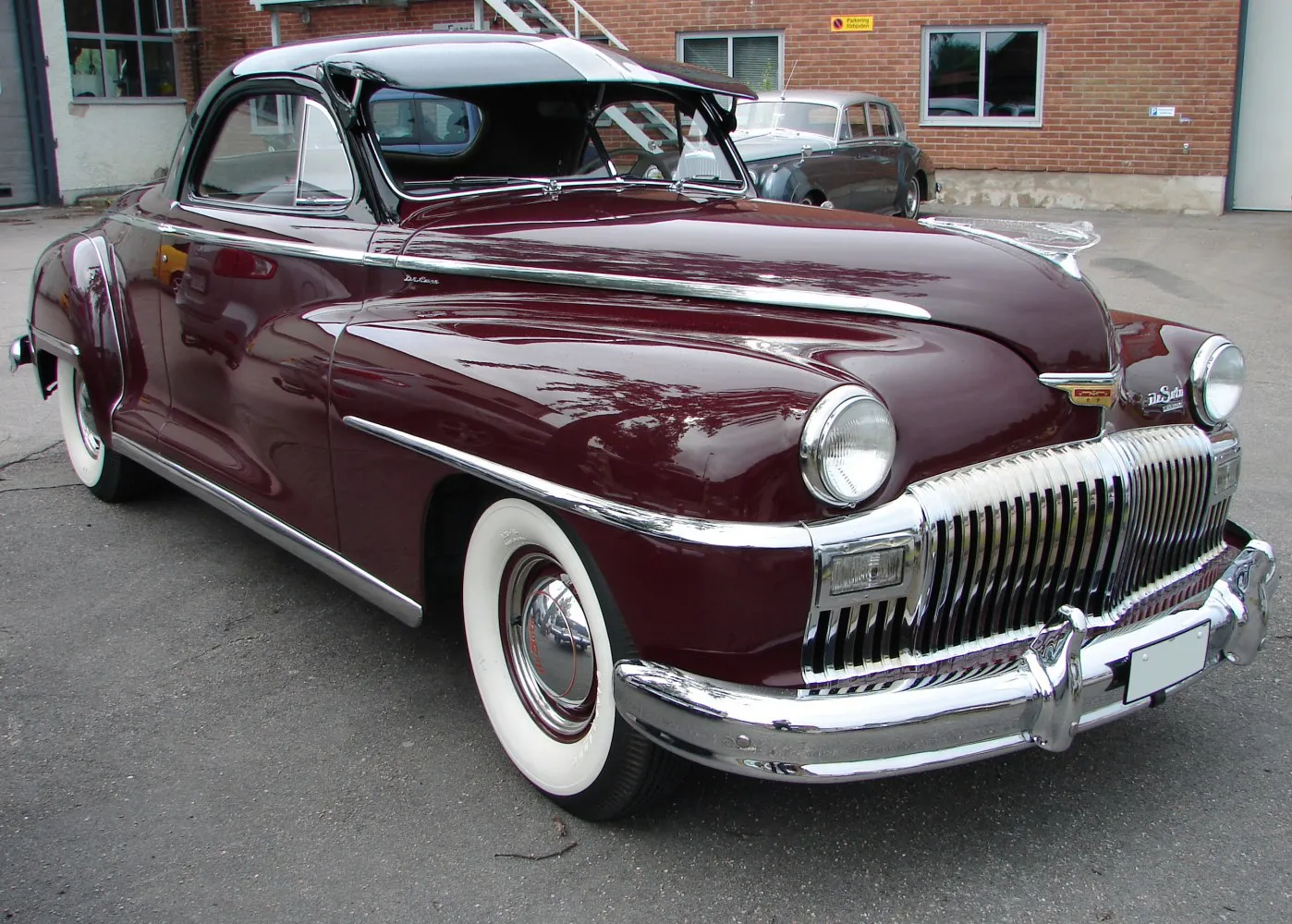
DeSoto Deluxe Station Wagon (Second Series) 3.9 (112 Hp) Tip-Toe Shift
Overall Rating
DeSoto Deluxe:
The DeSoto Series S-10 is an automobile produced by DeSoto from 1942 through to the 1952 model year. While in production, the Series S-10, which was sold with the trim package DeLuxe, was DeSoto's entry-level car, and was offered primarily as two-door and four-door sedans while the Custom offered upscale interiors and appearance including a 7-passenger sedan and the extended-wheelbase Suburban sedans. The body was claimed to be "rust proofed".
The DeLuxe differed from the more upmarket Custom line by having less trim, fewer standard features, and plainer interiors in fewer color combinations. A six-tube and an eight-tube radio were optional....(Read more on Wikipedia)
Station Wagon (Second Series) Overview:
DeSoto Deluxe (Station Wagon (Second Series)). With 264 Nm of torque, it offers ample pulling power. Rear‑wheel drive offers dynamic handling and sporty feedback. A car with an extended rear cargo area, combining passenger comfort with increased storage. With seating for 9, it’s perfect for larger families.
3.9 (112 Hp) Tip-Toe Shift Verdict:

Performance Verdict
Featuring DeSoto's innovative Tip-Toe Shift (semi-automatic) transmission, this trim offered smoother, more convenient driving than a full manual, with similar power delivery from the 3.9L engine, albeit with a slight trade-off in ultimate acceleration.
Fuel Economy
Fuel economy would be similar to the manual version, still poor by modern standards, but the semi-automatic transmission might offer slightly less efficiency than a perfectly shifted manual.
Pros and Cons:
Pros:
- • Spacious interior and seating for 9
- • Robust and relatively simple inline-six engine
- • Classic American styling and historical significance
- • Innovative Tip-Toe Shift option for its era
- • Good low-end torque for hauling
Cons:
- • Very poor fuel economy by modern standards
- • Lack of modern safety features
- • Dated driving dynamics and handling
- • Parts availability can be challenging for restoration
- • Drum brakes offer limited stopping power
Specifications:
Specifications are compared to those of the previous generation(3-Passenger Coupe: 1946 - 1949).
| General: | |
|---|---|
| Brand: | DeSoto |
| Model: | Deluxe |
| Generation: | Station Wagon (Second Series) |
| Modification (Engine): | 3.9 (112 Hp) Tip-Toe Shift |
| Start of production: | 1949 |
| End of production: | 1949 |
| Powertrain Architecture: | Internal Combustion engine |
| Body type: | Station wagon (estate) |
| Seats: | 9 |
| Doors: | 5 |
| Engine: | |
|---|---|
| Power: | 112 Hp @ 3600 rpm. |
| Power per litre: | 28.9 Hp/l |
| Torque: | 264 Nm @ 1600 rpm. |
| Engine displacement: | 3877 |
| Number of cylinders: | 6 |
| Engine configuration: | Inline |
| Number of valves per cylinder: | 2 |
| Fuel injection system: | Carburettor |
| Engine aspiration: | Naturally aspirated engine |
| Engine oil capacity: | 4.7 l |
| Coolant: | 16.1 l |
| Cylinder Bore: | 87.31 mm mm |
| Piston Stroke: | 107.95 mm mm |
| Compression ratio: | 7:1 |
| Performance: | |
|---|---|
| Fuel Type: | Petrol (Gasoline) |
| Space: | |
|---|---|
| Fuel tank capacity: | 61 l |
| Size: | |
|---|---|
| Length: | 5464 mm mm [199mm more] |
| Width: | 1862 mm mm [61mm less] |
| Height: | 1687 mm mm [Same height.] |
| Wheelbase: | 3188 mm mm [102mm more] |
| Minimum turning circle (turning diameter): | 13 m [above average] |
| Powertrain: | |
|---|---|
| Drivetrain Architecture | The Internal combustion engine (ICE) drives the rear wheels of the vehicle. |
| Drive wheel | Rear wheel drive |
| Number of gears | 4 |
| Transmission type | Automatic |
| Gearbox type | Tip-Toe Shift |
| Front brakes | Drum, 305 mm [bad for performance and cooling.] |
| Rear brakes | Drum, 305 mm [bad for performance and cooling.] |
| Front suspension | Independent coil spring |





Real owners, real reviews. Tell us about your DeSoto Deluxe.