
Click on image to view the full photo gallery
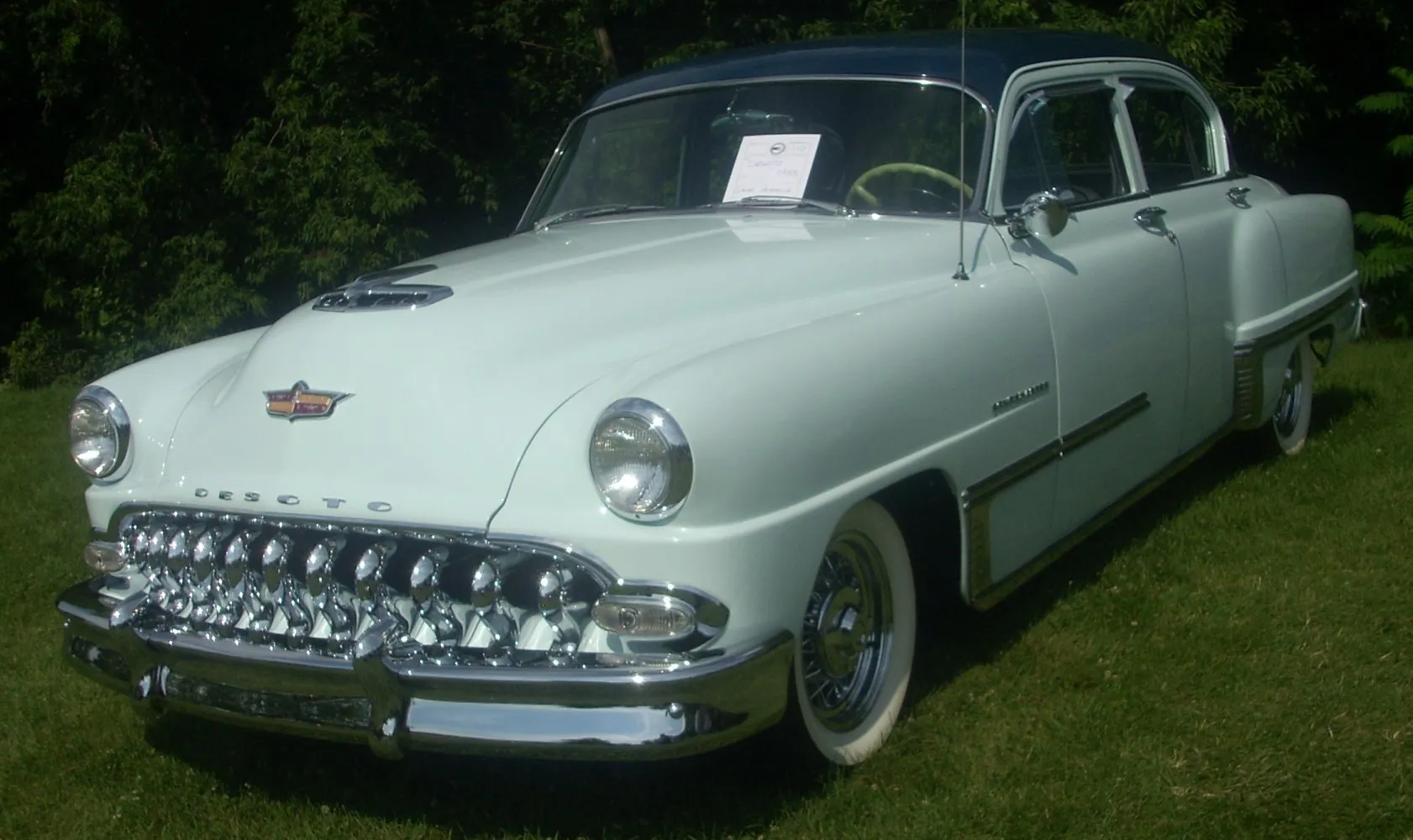
DeSoto Powermaster Six All-Steel Station Wagon 4.1 (116 Hp) Tip-Toe Shift
Overall Rating
DeSoto Powermaster Six:
The DeSoto Powermaster was an automobile built by DeSoto during model years 1952 to 1954. The car debuted during DeSoto's 25th anniversary, taking the place of the entry-level DeSoto Deluxe.
The Powermaster was a full-size car, offered in pillared two and four-door sedan and station wagon models, and powered by Chrysler's 251 cu in DeSoto I6 engine. For both of its years in production, the Powermaster was available as an eight-passenger sedan through the use of jump seats, called the DeSoto Suburban. The Powermaster was also built on a longer wheelbase ) than regular six-passenger DeSotos ). A version of the long wheelbase model was used as a basis for the DeSoto Taxi, seen in many Hollywood movies from the late 1930s through the mid-1950s....(Read more on Wikipedia)
All-Steel Station Wagon Overview:
DeSoto Powermaster Six (All-Steel Station Wagon). With 282 Nm of torque, it offers ample pulling power. Rear‑wheel drive offers dynamic handling and sporty feedback. A car with an extended rear cargo area, combining passenger comfort with increased storage. With seating for 6, it’s perfect for larger families.
4.1 (116 Hp) Tip-Toe Shift Verdict:

Performance Verdict
Offering the same robust 4.1L engine, the Tip-Toe Shift semi-automatic transmission enhanced driving convenience, making it smoother for city driving and less fatiguing on longer journeys compared to a full manual.
Fuel Economy
While offering convenience, the early semi-automatic Tip-Toe Shift likely resulted in similar or slightly worse fuel economy compared to the manual version, due to its design and efficiency.
Pros and Cons:
Pros:
- • Classic American styling and presence
- • Spacious interior ideal for families of the era
- • Robust and torquey inline-six engine
- • Historical significance as a post-war family vehicle
- • Comfortable ride quality for its time
Cons:
- • Very poor fuel economy by modern standards
- • Lack of modern safety features and crash protection
- • Dated handling and braking performance
- • Limited availability of specific parts for restoration
- • Requires significant maintenance for daily use
Specifications:
| General: | |
|---|---|
| Brand: | DeSoto |
| Model: | Powermaster Six |
| Generation: | All-Steel Station Wagon |
| Modification (Engine): | 4.1 (116 Hp) Tip-Toe Shift |
| Start of production: | 1952 |
| End of production: | 1953 |
| Powertrain Architecture: | Internal Combustion engine |
| Body type: | Station wagon (estate) |
| Seats: | 6 |
| Doors: | 5 |
| Engine: | |
|---|---|
| Power: | 116 Hp @ 3600 rpm. |
| Power per litre: | 28.3 Hp/l |
| Torque: | 282 Nm @ 1600 rpm. |
| Engine displacement: | 4106 |
| Number of cylinders: | 6 |
| Engine configuration: | Inline |
| Number of valves per cylinder: | 2 |
| Fuel injection system: | Carburettor |
| Engine aspiration: | Naturally aspirated engine |
| Engine oil capacity: | 4.7 l |
| Coolant: | 15.1 l |
| Cylinder Bore: | 87.31 mm mm |
| Piston Stroke: | 114.3 mm mm |
| Compression ratio: | 7:1 |
| Performance: | |
|---|---|
| Fuel Type: | Petrol (Gasoline) |
| Size: | |
|---|---|
| Length: | 5404 mm mm |
| Width: | 1963 mm mm |
| Height: | 1588 mm mm |
| Wheelbase: | 3188 mm mm |
| Front track: | 1430 mm |
| Rear (Back) track: | 1513 mm |
| Minimum turning circle (turning diameter): | 13 m |
| Powertrain: | |
|---|---|
| Drivetrain Architecture | The Internal combustion engine (ICE) drives the rear wheels of the vehicle. |
| Drive wheel | Rear wheel drive |
| Number of gears | 4 |
| Transmission type | Automatic |
| Gearbox type | Tip-Toe Shift |
| Front brakes | Drum, 305 mm |
| Rear brakes | Drum, 305 mm |
| Front suspension | Independent coil spring |
| Rear suspension | Leaf spring |






Your first impression of the DeSoto Powermaster Six in one word? Go!