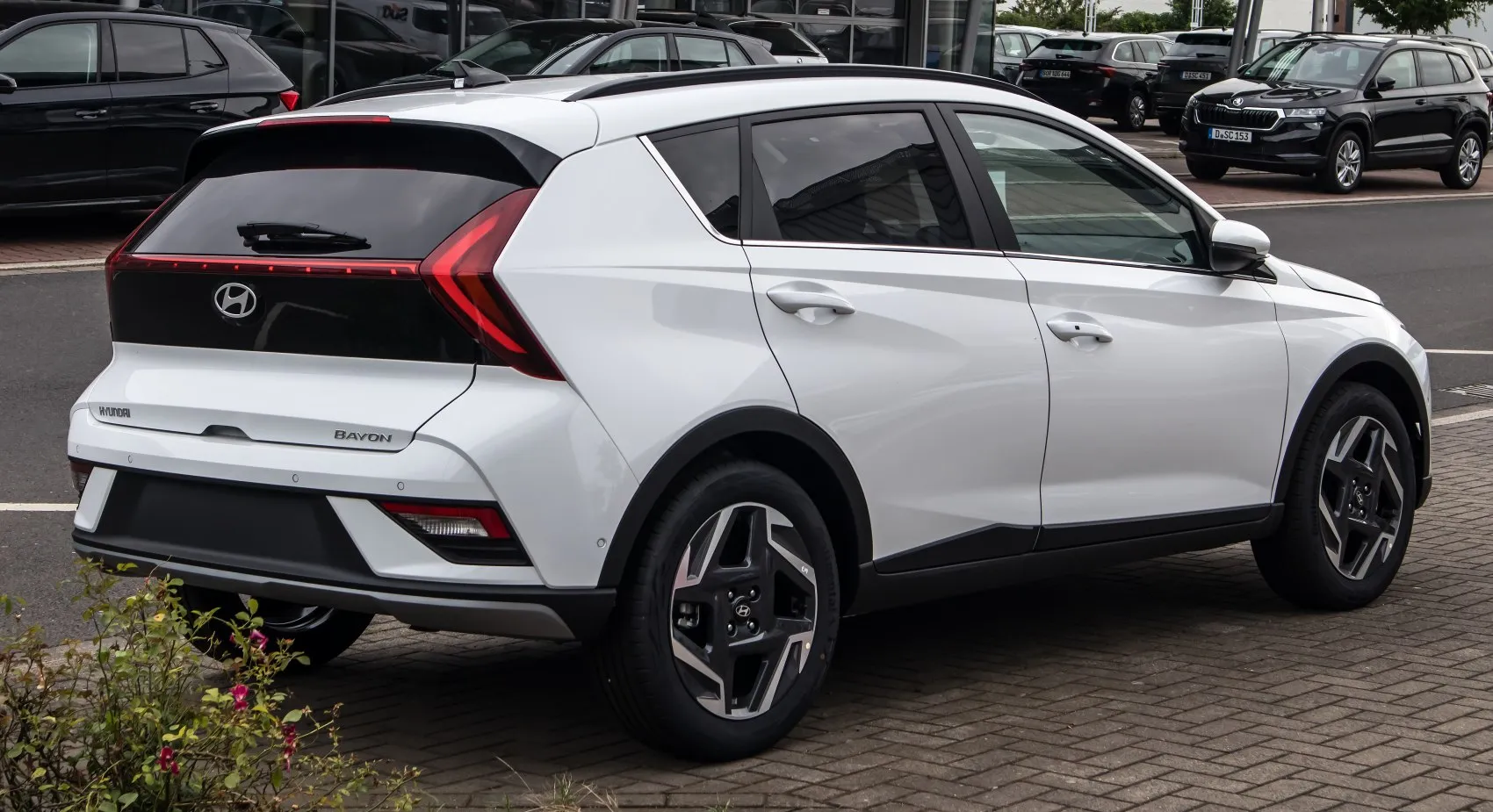
Hyundai Bayon facelift 2024 1.0 T-GDI (100 Hp)
Hyundai Bayon:
The Hyundai Bayon is a five-door subcompact crossover SUV produced by the South Korean manufacturer Hyundai. The Bayon is based on the third-generation i20 and is not offered with all-wheel drive.
Revealed in March 2021, it is Hyundai's smallest SUV in their European line-up and slots below the Kona.
Designed primarily for the European market, the vehicle's name is a reference to the French city of Bayonne. Outside of Europe and Turkey, it is only offered in selected markets in Central Asia, Middle East and North Africa....(Read more on Wikipedia)
facelift 2024 Overview:
Hyundai Bayon (facelift 2024). With 172 Nm of torque, it offers ample pulling power. Weighing only 1150 kg, it’s quite light. Front‑wheel drive delivers efficiency and easy handling. Acceleration is relatively slow (0–100 km/h in 11.3 s). The top speed reaches 179 km/h. A sport utility vehicle offering higher ground clearance and versatile cargo space. A vehicle that combines characteristics of SUVs and hatchbacks for versatility. Seating for 5 makes it ideal for daily use.
Pros and Cons:
Pros:
- • Efficiency-focused engine (100 hp), ideal for city commuting.
- • Steady and predictable acceleration (0-100 km/h in 11.3 sec).
- • Exceptional fuel efficiency: 5.5 L/100 km.
- • Ventilated disc brakes for reliable cooling and stopping power.
- • Standard trunk space (411 L) suitable for daily needs.
- • Turbocharged engine ensures better torque delivery at low RPMs.
- • Direct fuel injection technology for optimized combustion.
Specifications:
| General: |
| Brand: | Hyundai |
|---|
| Model: | Bayon |
|---|
| Generation: | facelift 2024 |
|---|
| Modification (Engine): | 1.0 T-GDI (100 Hp) |
|---|
| Start of production: | June, 2024 |
|---|
| Powertrain Architecture: | Internal Combustion engine |
|---|
| Body type: | SUV, Crossover |
|---|
| Seats: | 5 |
|---|
| Doors: | 5 |
|---|
| Engine: |
| Engine systems: | Start & Stop System |
|---|
| Power: | 100 Hp @ 6000 rpm. |
|---|
| Power per litre: | 100.2 Hp/l |
|---|
| Torque: | 172 Nm @ 1500-3500 rpm. |
|---|
| Engine Model/Code: | Smartstream/G3LE |
|---|
| Engine displacement: | 998 |
|---|
| Number of cylinders: | 3 |
|---|
| Engine configuration: | Inline |
|---|
| Number of valves per cylinder: | 4 |
|---|
| Fuel injection system: | Direct injection |
|---|
| Engine aspiration: | Turbocharger, Intercooler |
|---|
| Valvetrain: | DOHC |
|---|
| Engine oil capacity: | 3.6 l |
|---|
| Coolant: | 5.77 l |
|---|
| Engine layout: | Front, Transverse |
|---|
| Cylinder Bore: | 71 mm |
|---|
| Piston Stroke: | 84 mm |
|---|
| Compression ratio: | 10.5:1 |
|---|
| Performance: |
| Fuel Type: | Petrol (Gasoline) |
|---|
| Combined fuel consumption (WLTP): | 5.5-5.6 l/100 km |
|---|
| Fuel consumption at Low speed (WLTP): | 7.2-7.3 l/100 km |
|---|
| Fuel consumption at Medium speed (WLTP): | 5.2-5.3 l/100 km |
|---|
| Fuel consumption at high speed (WLTP): | 4.6-4.7 l/100 km |
|---|
| Fuel consumption at very high speed (WLTP): | 5.7-5.8 l/100 km |
|---|
| Emission standard: | Euro 6E |
|---|
| Acceleration 0 - 100 km/h: | 11.3 sec |
|---|
| Acceleration 0 - 62 mph: | 11.3 sec |
|---|
| Maximum speed: | 179 km/h |
|---|
| Weight-to-power ratio: | 11 kg/Hp, 91.3 Hp/tonne |
|---|
| Weight-to-torque ratio: | 6.4 kg/Nm, 157.1 Nm/tonne |
|---|
| Acceleration 0 - 60 mph: | 10.7 sec |
|---|
| Space: |
| Kerb Weight: | 1095-1205 |
|---|
| Max. weight: | 1630 |
|---|
| Max. roof load: | 70 kg |
|---|
| Max load: | 425-535 |
|---|
| Trunk (boot) space - maximum: | 1205 l |
|---|
| Trunk (boot) space - minimum: | 411 l |
|---|
| Permitted trailer load with brakes (12%): | 910 kg |
|---|
| Fuel tank capacity: | 40 l |
|---|
| Permitted trailer load without brakes: | 450 kg |
|---|
| Size: |
| Length: | 4180 mm |
|---|
| Width: | 1775 mm |
|---|
| Height: | 1500 mm |
|---|
| Wheelbase: | 2580 mm |
|---|
| Front track: | 1545-1546 mm |
|---|
| Rear (Back) track: | 1551-1552 mm |
|---|
| Minimum turning circle (turning diameter): | 10.4 m |
|---|
| Powertrain: |
| Drivetrain Architecture | The Internal combustion engine (ICE) drives the front wheels of the vehicle. |
|---|
| Drive wheel | Front wheel drive |
|---|
| Number of gears | 6 |
|---|
| Transmission type | Manual |
|---|
| Front brakes | Ventilated discs, 280 mm |
|---|
| Rear brakes | Disc, 262 mm |
|---|
| Assisting systems | ABS (Anti-lock braking system) |
|---|
| Steering type | Steering rack and pinion |
|---|
| Power steering | Electric Steering |
|---|
| Tires size | 195/55 R16; 205/55 R17 |
|---|
| Wheel rims size | 6.0J x 16; 6.5J x 17 |
|---|
| Front suspension | Independent type McPherson |
|---|
| Rear suspension | Torsion |
|---|








What’s the best feature of the Hyundai Bayon? Tell us in the comments!