
Click on image to view the full photo gallery
Hyundai Tucson IV 1.6 CRDi (136 Hp) Mild Hybrid 4WD DCT
Overall Rating
Hyundai Tucson:
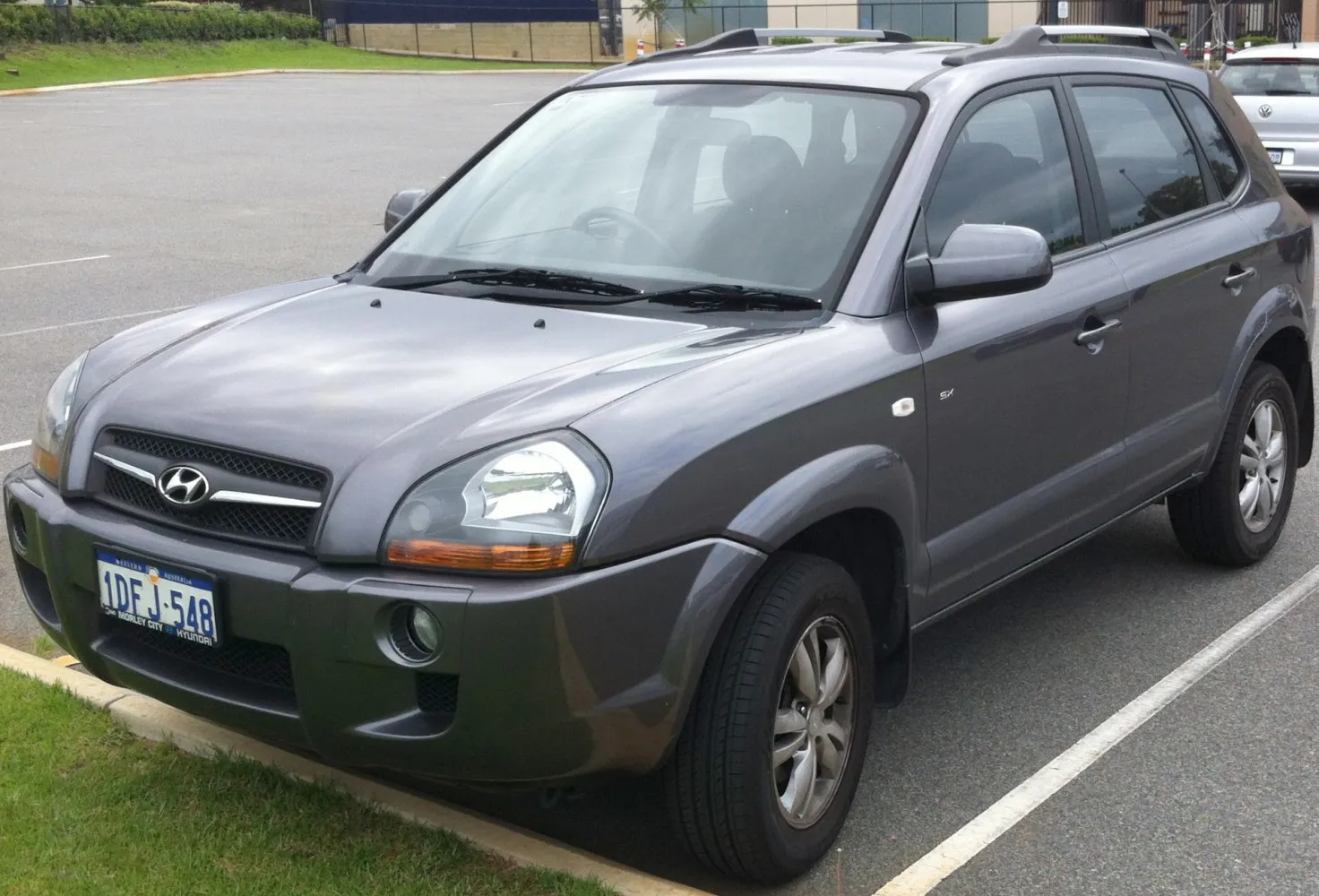
The Hyundai Tucson is a compact crossover SUV produced by the South Korean manufacturer Hyundai. It is named after the city of Tucson, Arizona, U. S.
The second-generation model was marketed as the Hyundai ix35 in several markets, including Europe, Australia and China, before reverting to Tucson for the third-generation. Since its first-generation, the Tucson has been developed alongside the Kia Sportage, sharing platforms and engines.
The Tucson is the best-selling Hyundai model, with more than 7 million units sold globally since it launched in 2004. Of these, 1. 4 million units have been sold in Europe....(Read more on Wikipedia)
IV Overview:
Hyundai Tucson (IV). With 320 Nm of torque, it offers ample pulling power. It boasts low fuel consumption (~4.7 l/100km). With a weight of 1659 kg, it falls in the mid‑range. All‑wheel drive provides excellent grip, ideal for off‑road use. Acceleration is relatively slow (0–100 km/h in 11.6 s). The top speed reaches 180 km/h. A sport utility vehicle offering higher ground clearance and versatile cargo space. Seating for 5 makes it ideal for daily use.
The Hyundai Tucson IV achieved a commendable 5-star Euro NCAP rating in 2021, demonstrating strong adult and child occupant protection, though vulnerable road user protection could be improved.
1.6 CRDi (136 Hp) Mild Hybrid 4WD DCT Verdict:

Performance Verdict
Improved power over the 116hp diesel, combined with the DCT and 4WD for a more versatile driving experience.
Fuel Economy
Excellent fuel economy, making it one of the most efficient AWD options, ideal for long distances.
Pros and Cons:
Pros:
- • Striking modern design
- • Wide range of efficient powertrains (including hybrids/PHEVs)
- • Spacious and practical interior
- • Generous standard features and technology
- • Strong safety ratings
Cons:
- • Some engine variants can feel underpowered
- • Fuel economy can be average for non-hybrid petrol models
- • Infotainment system can be complex for some users
- • Ride can be firm on larger wheels
- • Rear visibility can be limited due to design
Specifications:
Specifications are compared to those of the previous generation(III (facelift 2018): April, 2019 - December, 2020).
| General: | |
|---|---|
| Brand: | Hyundai |
| Model: | Tucson |
| Generation: | IV |
| Modification (Engine): | 1.6 CRDi (136 Hp) Mild Hybrid 4WD DCT |
| Start of production: | December, 2020 |
| End of production: | October, 2023 |
| Powertrain Architecture: | MHEV (Mild Hybrid Electric Vehicle, power-assist hybrid, battery-assisted hybrid vehicles, BAHV) |
| Body type: | SUV |
| Seats: | 5 |
| Doors: | 5 |
| Engine: | |
|---|---|
| Engine systems: | Start & Stop System |
| Power: | 136 Hp @ 4000 rpm. Same horsepower |
| Power per litre: | 85.1 Hp/l [20mm more] |
| Torque: | 320 Nm @ 2000-2250 rpm. |
| Engine Model/Code: | D4FE More details about the engine D4FE |
| Engine displacement: | 1598 |
| Number of cylinders: | 4 |
| Engine configuration: | Inline |
| Number of valves per cylinder: | 4 |
| Fuel injection system: | Diesel Commonrail |
| Engine aspiration: | Twin-Turbo, Intercooler |
| Engine oil capacity: | 4.4 l |
| Coolant: | 7.2 l |
| Engine layout: | Front, Transverse |
| Cylinder Bore: | 76.99 mm mm |
| Piston Stroke: | 85.8 mm mm |
| Compression ratio: | 15.9:1 |
| Performance: | |
|---|---|
| Fuel Type: | Diesel |
| Fuel consumption (economy) - urban: | 4.7 l/100 km |
| Fuel consumption (economy) - extra urban: | 4.7 l/100 km |
| Fuel consumption (economy) - urban (NEDC, WLTP equivalent): | 4.7 l/100 km |
| Fuel consumption (economy) - extra urban (NEDC, WLTP equivalent): | 4.7 l/100 km |
| Fuel consumption (economy) - combined (NEDC, WLTP equivalent): | 4.7 l/100 km |
| Fuel consumption (economy) - combined: | 4.7 l/100 km |
| Emission standard: | Euro 6d |
| Acceleration 0 - 100 km/h: | 11.6 sec |
| Acceleration 0 - 62 mph: | 11.6 sec |
| Maximum speed: | 180 km/h |
| Weight-to-power ratio: | 11.7 kg/Hp, 85.5 Hp/tonne |
| Weight-to-torque ratio: | 5 kg/Nm, 201.3 Nm/tonne |
| Acceleration 0 - 60 mph: | 11 sec |
| Space: | |
|---|---|
| Kerb Weight: | 1590-1729 |
| Max. weight: | 2200 |
| Max. roof load: | 100 kg |
| Max load: | 471-610 |
| Trunk (boot) space - maximum: | 1725 l |
| Trunk (boot) space - minimum: | 546 l |
| Permitted trailer load with brakes (12%): | 1650 kg |
| Fuel tank capacity: | 54 l |
| Permitted trailer load without brakes: | 750 kg |
| Permitted towbar download: | 100 kg |
| Size: | |
|---|---|
| Ramp-over (brakeover) angle: | 16.7° |
| Length: | 4500 mm mm [20mm more] |
| Width: | 1865 mm mm [15mm more] |
| Height: | 1651-1653 mm mm [1mm more] |
| Wheelbase: | 2680 mm mm [10mm more] |
| Width including mirrors: | 2130 mm |
| Front track: | 1615-1630 mm |
| Rear (Back) track: | 1622-1637 mm |
| Front overhang: | 895 mm |
| Rear overhang: | 925 mm |
| Ride height (ground clearance): | 170 mm |
| Minimum turning circle (turning diameter): | 10.92 m [above average] |
| Approach angle: | 17.4° |
| Departure angle: | 25.7° |
| Powertrain: | |
|---|---|
| Drivetrain Architecture | The Internal combustion engine (ICE) and the electric motor permanently drive the front wheels of the vehicle, capable of running only in mixed mode, and if necessary through the electrically or mechanically controlled clutch, the rear wheels are driven. |
| Drive wheel | All wheel drive (4x4) |
| Number of gears | 7 |
| Transmission type | Automatic |
| Gearbox type | DCT |
| Front brakes | Ventilated discs, 291 mm [Best for performance and cooling.] |
| Rear brakes | Disc, 302 mm [above average] |
| Assisting systems | ABS (Anti-lock braking system) |
| Steering type | Steering rack and pinion |
| Power steering | Electric Steering |
| Tires size | 215/65 R17; 235/55 R18; 235/50 R19 |
| Wheel rims size | 7.0J x 17; 7.5J x 18; 7.5J x 19 |
| Front suspension | Independent, type McPherson with coil spring and anti-roll bar |
| Rear suspension | Independent multi-link spring suspension with stabilizer |
| Electric: | |
|---|---|
| Gross battery capacity: | 0.44 kWh |








Does the Hyundai Tucson live up to the hype? Give us your verdict!