
Click on image to view the full photo gallery
Hyundai Tucson IV 1.6 T-GDI (150 Hp)
Overall Rating
Hyundai Tucson:
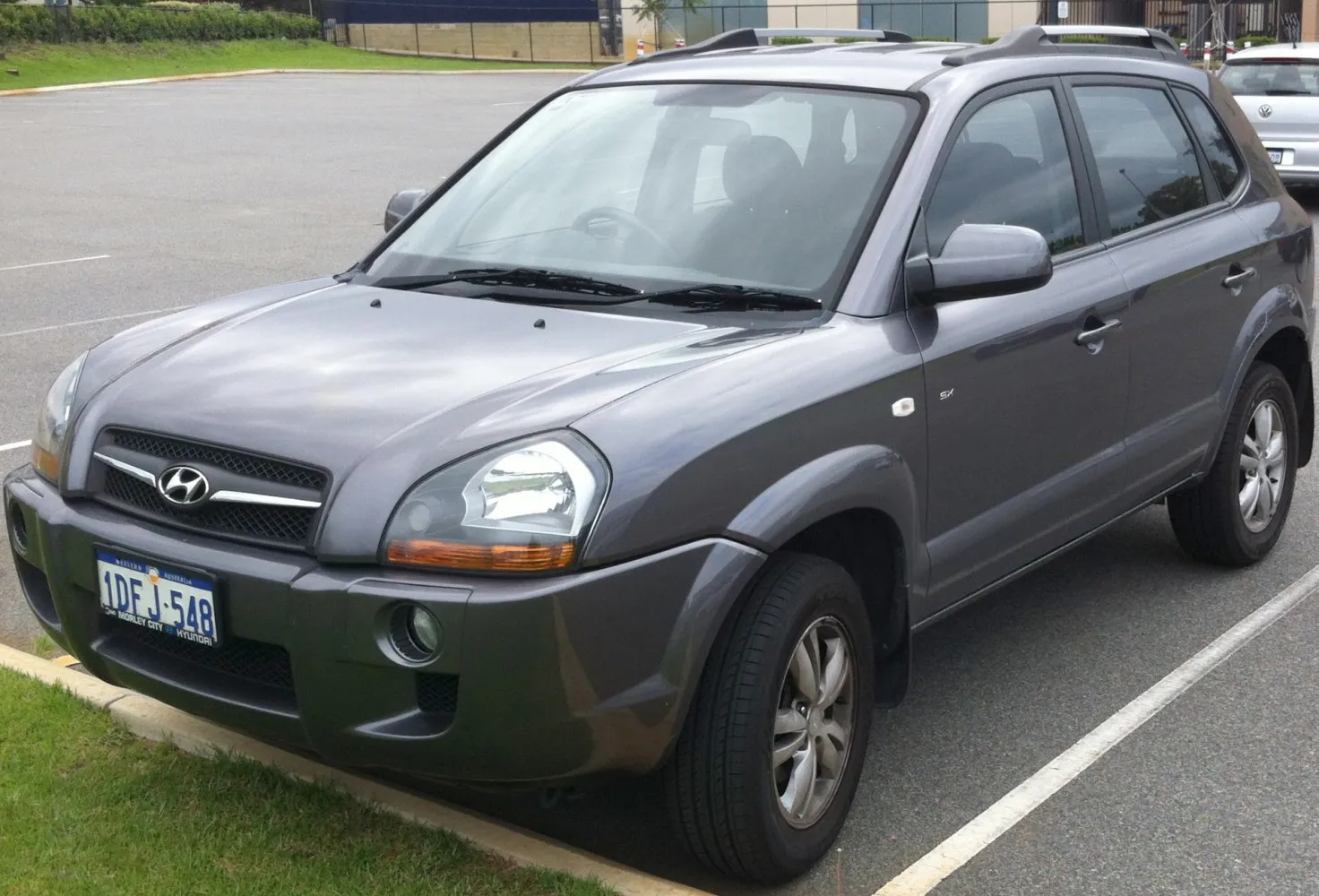
The Hyundai Tucson is a compact crossover SUV produced by the South Korean manufacturer Hyundai. It is named after the city of Tucson, Arizona, U. S.
The second-generation model was marketed as the Hyundai ix35 in several markets, including Europe, Australia and China, before reverting to Tucson for the third-generation. Since its first-generation, the Tucson has been developed alongside the Kia Sportage, sharing platforms and engines.
The Tucson is the best-selling Hyundai model, with more than 7 million units sold globally since it launched in 2004. Of these, 1. 4 million units have been sold in Europe....(Read more on Wikipedia)
IV Overview:
Hyundai Tucson (IV). With 250 Nm of torque, it offers ample pulling power. It has moderate fuel consumption (~7.6 l/100km). With a weight of 1500 kg, it falls in the mid‑range. Front‑wheel drive delivers efficiency and easy handling. Acceleration is relatively slow (0–100 km/h in 10.3 s). The top speed reaches 189 km/h. A sport utility vehicle offering higher ground clearance and versatile cargo space. Seating for 5 makes it ideal for daily use.
The Hyundai Tucson IV achieved a commendable 5-star Euro NCAP rating in 2021, demonstrating strong adult and child occupant protection, though vulnerable road user protection could be improved.
1.6 T-GDI (150 Hp) Verdict:

Performance Verdict
Adequate power for daily driving, but not particularly sporty. Acceleration is average for the segment.
Fuel Economy
Reasonable fuel economy for a non-hybrid petrol SUV, especially on longer runs.
Pros and Cons:
Pros:
- • Striking modern design
- • Wide range of efficient powertrains (including hybrids/PHEVs)
- • Spacious and practical interior
- • Generous standard features and technology
- • Strong safety ratings
Cons:
- • Some engine variants can feel underpowered
- • Fuel economy can be average for non-hybrid petrol models
- • Infotainment system can be complex for some users
- • Ride can be firm on larger wheels
- • Rear visibility can be limited due to design
Specifications:
Specifications are compared to those of the previous generation(III (facelift 2018): April, 2019 - December, 2020).
| General: | |
|---|---|
| Brand: | Hyundai |
| Model: | Tucson |
| Generation: | IV |
| Modification (Engine): | 1.6 T-GDI (150 Hp) |
| Start of production: | December, 2020 |
| End of production: | May, 2024 |
| Powertrain Architecture: | Internal Combustion engine |
| Body type: | SUV |
| Seats: | 5 |
| Doors: | 5 |
| Engine: | |
|---|---|
| Engine systems: | Start & Stop System |
| Power: | 150 Hp @ 5500 rpm. Same horsepower |
| Power per litre: | 93.9 Hp/l [20mm more] |
| Torque: | 250 Nm @ 1500-4000 rpm. |
| Engine Model/Code: | G4FP More details about the engine G4FP |
| Engine displacement: | 1598 |
| Number of cylinders: | 4 |
| Engine configuration: | Inline |
| Number of valves per cylinder: | 4 |
| Fuel injection system: | Direct injection |
| Engine aspiration: | Twin-Turbo, Intercooler |
| Valvetrain: | DOHC |
| Engine oil capacity: | 4.8 l |
| Coolant: | 7.9 l |
| Engine layout: | Front, Transverse |
| Cylinder Bore: | 75.6 mm mm |
| Piston Stroke: | 89 mm mm |
| Compression ratio: | 10.5:1 |
| Performance: | |
|---|---|
| Fuel Type: | Petrol (Gasoline) |
| Fuel consumption (economy) - urban: | 7.6 l/100 km |
| Fuel consumption (economy) - extra urban: | 5.5 l/100 km |
| Combined fuel consumption (WLTP): | 6.7-6.8 l/100 km |
| Fuel consumption at Low speed (WLTP): | 8.3-8.4 l/100 km |
| Fuel consumption at Medium speed (WLTP): | 6.4-6.6 l/100 km |
| Fuel consumption at high speed (WLTP): | 5.7-5.9 l/100 km |
| Fuel consumption at very high speed (WLTP): | 7.0-7.2 l/100 km |
| Fuel consumption (economy) - urban (NEDC, WLTP equivalent): | 7.6 l/100 km |
| Fuel consumption (economy) - extra urban (NEDC, WLTP equivalent): | 5.5 l/100 km |
| Fuel consumption (economy) - combined (NEDC, WLTP equivalent): | 6.3 l/100 km |
| Fuel consumption (economy) - combined: | 6.3 l/100 km |
| Emission standard: | Euro 6d |
| Acceleration 0 - 100 km/h: | 10.3 sec |
| Acceleration 0 - 62 mph: | 10.3 sec |
| Maximum speed: | 189 km/h |
| Weight-to-power ratio: | 9.5 kg/Hp, 105.3 Hp/tonne |
| Weight-to-torque ratio: | 5.7 kg/Nm, 175.4 Nm/tonne |
| Acceleration 0 - 60 mph: | 9.8 sec |
| Space: | |
|---|---|
| Kerb Weight: | 1425-1575 |
| Max. weight: | 2050 |
| Max. roof load: | 100 kg |
| Max load: | 475-625 |
| Trunk (boot) space - maximum: | 1799 l |
| Trunk (boot) space - minimum: | 620 l |
| Permitted trailer load with brakes (12%): | 1650 kg |
| Fuel tank capacity: | 54 l |
| Permitted trailer load without brakes: | 750 kg |
| Permitted towbar download: | 100 kg |
| Size: | |
|---|---|
| Ramp-over (brakeover) angle: | 17.3° |
| Length: | 4500 mm mm [20mm more] |
| Width: | 1865 mm mm [15mm more] |
| Height: | 1651 mm mm [1mm more] |
| Wheelbase: | 2680 mm mm [10mm more] |
| Width including mirrors: | 2130 mm |
| Front track: | 1615-1630 mm |
| Rear (Back) track: | 1622-1637 mm |
| Front overhang: | 895 mm |
| Rear overhang: | 925 mm |
| Ride height (ground clearance): | 170 mm |
| Minimum turning circle (turning diameter): | 10.92 m [above average] |
| Approach angle: | 17.4° |
| Departure angle: | 25.7° |
| Powertrain: | |
|---|---|
| Drivetrain Architecture | The Internal combustion engine (ICE) drives the front wheels of the vehicle. |
| Drive wheel | Front wheel drive |
| Number of gears | 6 |
| Transmission type | Manual |
| Front brakes | Ventilated discs, 291 mm [Best for performance and cooling.] |
| Rear brakes | Disc, 302 mm [above average] |
| Assisting systems | ABS (Anti-lock braking system) |
| Steering type | Steering rack and pinion |
| Power steering | Electric Steering |
| Tires size | 215/65 R17; 235/55 R18; 235/50 R19 |
| Wheel rims size | 7.0J x 17; 7.5J x 18; 7.5J x 19 |
| Front suspension | Independent, type McPherson with coil spring and anti-roll bar |
| Rear suspension | Independent multi-link spring suspension with stabilizer |








Have you ever driven an Hyundai Tucson?
How was your experience with it? Share with us: