
Click on image to view the full photo gallery
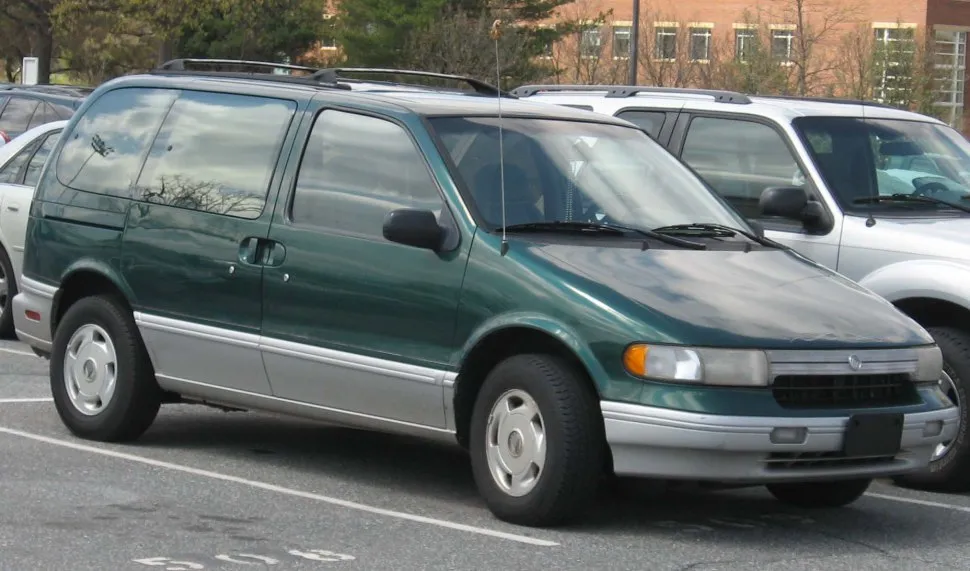
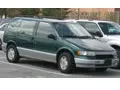
Mercury Villager II 3.3 V6 (173 Hp)
Overall Rating
Mercury Villager:
The Mercury Villager is a minivan that was marketed by Mercury from 1993 to 2002. Taking its name used by Mercury to denote its wood-trimmed station wagons, the Villager was developed in a joint venture between Ford and Nissan; the latter manufacturer marketed the line as the Nissan Quest. The first front-wheel drive van produced by Ford, the Mercury Villager was introduced between the Ford Aerostar and the Ford Windstar, competing against Chrysler minivans and the General Motors APV minivans.
Two generations of the model line were produced, with the Villager undergoing a full redesign for 1999. In a first for the minivan segment, the model line replaced a removable rear seat with a design that was repositionable. The Villager was the last Mercury developed with the lightbar grille used by the brand....(Read more on Wikipedia)
II Overview:
Mercury Villager (II). With 271 Nm of torque, it offers ample pulling power. With a weight of 1815 kg, it falls in the mid‑range. Front‑wheel drive delivers efficiency and easy handling. Acceleration is relatively slow (0–100 km/h in 11 s). The top speed reaches 176 km/h. A spacious vehicle designed to transport passengers comfortably, often with sliding doors. With seating for 7, it’s perfect for larger families.
The Mercury Villager II was not tested by Euro NCAP. As a North American market minivan from its era, it would have been subject to NHTSA and IIHS testing, which generally showed adequate but not class-leading safety for its time.
3.3 V6 (173 Hp) Verdict:

Performance Verdict
The 3.3L V6 provides adequate power (173 Hp) for daily driving and highway cruising, offering sufficient acceleration for a family minivan without being particularly sporty.
Fuel Economy
Fuel economy of 11.5 l/100 km combined is typical for a V6 minivan of this vintage, neither exceptional nor poor, reflecting the technology of its time.
Pros and Cons:
Pros:
- • Spacious and versatile interior for families
- • Generally reliable Nissan-sourced V6 engine (VG33E)
- • Comfortable ride quality for long journeys
- • Good value on the used market
Cons:
- • Dated styling and interior compared to newer rivals
- • Fuel economy is average for its class and era
- • Limited advanced safety features by modern standards
- • Rear drum brakes on some models
Specifications:
Specifications are compared to those of the previous generation(I: 1995 - 1998).
| General: | |
|---|---|
| Brand: | Mercury |
| Model: | Villager |
| Generation: | II |
| Modification (Engine): | 3.3 V6 (173 Hp) |
| Start of production: | 1998 |
| End of production: | 2002 |
| Powertrain Architecture: | Internal Combustion engine |
| Body type: | Minivan |
| Seats: | 7 |
| Doors: | 4 |
| Engine: | |
|---|---|
| Power: | 173 Hp @ 4800 rpm. Same horsepower |
| Power per litre: | 52.8 Hp/l [127mm more] |
| Torque: | 271 Nm @ 2800 rpm. |
| Engine Model/Code: | VG33E More details about the engine VG33E |
| Engine displacement: | 3275 |
| Number of cylinders: | 6 |
| Engine configuration: | V-engine |
| Number of valves per cylinder: | 2 |
| Fuel injection system: | Multi-port manifold injection |
| Engine aspiration: | Naturally aspirated engine |
| Valvetrain: | OHC |
| Engine oil capacity: | 4 l |
| Coolant: | 10.6 l |
| Engine layout: | Front, Transverse |
| Cylinder Bore: | 91.5 mm mm |
| Piston Stroke: | 83 mm mm |
| Compression ratio: | 9:1 |
| Performance: | |
|---|---|
| Fuel Type: | Petrol (Gasoline) |
| Fuel consumption (economy) - urban: | 13.8 l/100 km |
| Fuel consumption (economy) - extra urban: | 9.8 l/100 km |
| Fuel consumption (economy) - combined: | 11.5 l/100 km |
| Acceleration 0 - 100 km/h: | 11 sec |
| Acceleration 0 - 62 mph: | 11 sec |
| Maximum speed: | 176 km/h |
| Weight-to-power ratio: | 10.5 kg/Hp, 95.3 Hp/tonne |
| Weight-to-torque ratio: | 6.7 kg/Nm, 149.3 Nm/tonne |
| Acceleration 0 - 60 mph: | 10.5 sec |
| Space: | |
|---|---|
| Kerb Weight: | 1815 |
| Trunk (boot) space - maximum: | 3840 l |
| Trunk (boot) space - minimum: | 305 l |
| Fuel tank capacity: | 76 l |
| Size: | |
|---|---|
| Length: | 4950 mm mm [127mm more] |
| Width: | 1900 mm mm [28mm more] |
| Height: | 1780 mm mm [63mm more] |
| Wheelbase: | 2850 mm mm [Same wheelbase.] |
| Front track: | 1610 mm |
| Rear (Back) track: | 1610 mm |
| Powertrain: | |
|---|---|
| Drivetrain Architecture | The Internal combustion engine (ICE) drives the front wheels of the vehicle. |
| Drive wheel | Front wheel drive |
| Number of gears | 4 |
| Transmission type | Automatic |
| Front brakes | Ventilated discs [Best for performance and cooling.] |
| Rear brakes | Drum [bad for performance and cooling.] |
| Assisting systems | ABS (Anti-lock braking system) |
| Steering type | Steering rack and pinion |
| Power steering | Hydraulic Steering |
| Tires size | 215/75 R15 |
| Front suspension | Wishbone |
| Rear suspension | Leaf spring |






Is the Mercury Villager worth every penny? Give us your honest ROI.