
Click on image to view the full photo gallery
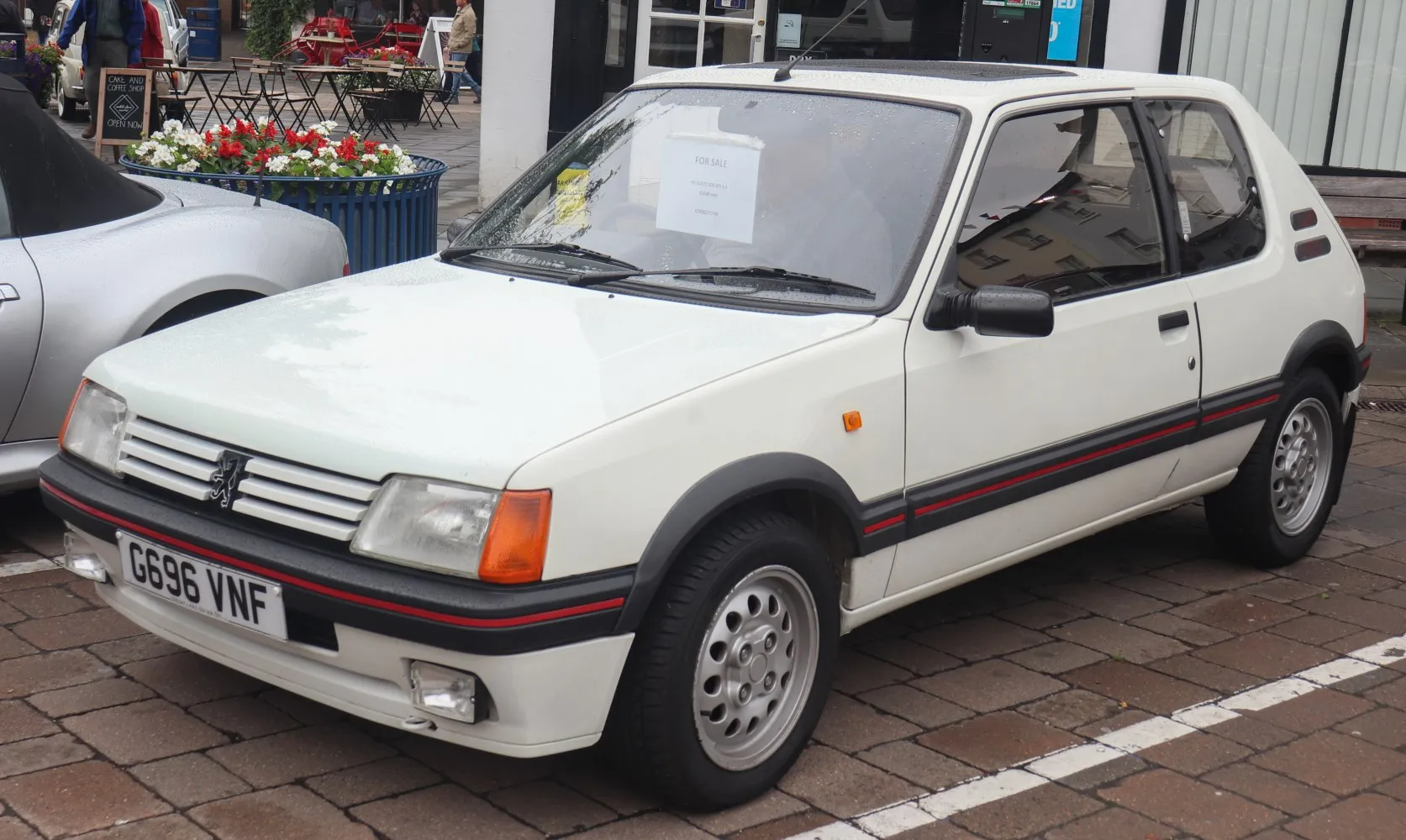
Peugeot 205 I (20A/C, facelift 1987) 3-door 1.9 GTI (130 Hp)
Overall Rating
Peugeot 205:
The Peugeot 205 is a four-passenger, front-engine, supermini car manufactured and marketed by Peugeot over a sixteen-year production run from 1983 to 1999, over a single generation. Developed from Projet M24 and introduced on 25 February 1983, the 205 replaced the Peugeot 104 and the Talbot Samba, using major elements from their design. It won What Car?'s Car of the Year for 1984. It was also declared "car of the decade" by CAR Magazine in 1990. Peugeot stopped marketing the 205 in 1999 in favor of its new front-engined 206. The 106, which was introduced in 1991, effectively took over as Peugeot's smaller front-engined model in their lineup. The latter was developed as a close sibling of the Citroën AX, sharing many components and a platform that later evolved into the Citroën Saxo....(Read more on Wikipedia)
I (20A/C, facelift 1987) 3-door Overview:
Peugeot 205 (I (20A/C, facelift 1987) 3-door). With 175 Nm of torque, it offers ample pulling power. It has moderate fuel consumption (~9.7 l/100km). Weighing only 880 kg, it’s quite light. Front‑wheel drive delivers efficiency and easy handling. Acceleration is good (0–100 km/h in 7.8 s). The top speed reaches 206 km/h. A compact car with a rear door that swings upward to provide access to the cargo area. Seating for 5 makes it ideal for daily use.
1.9 GTI (130 Hp) Verdict:

Performance Verdict
The pinnacle of 205 performance, delivering exhilarating acceleration and a truly legendary hot hatch experience. Highly sought after.
Fuel Economy
While not a focus, it offers reasonable economy for its performance, though specific data is not provided in the reference.
Pros and Cons:
Pros:
- • Exceptional handling and driving dynamics, especially in GTI and Rallye trims.
- • Iconic and timeless design, still highly appealing today.
- • Practical and compact size, excellent for urban environments.
- • Wide range of engines, from economical diesels to high-performance petrols.
- • Strong community and aftermarket support for enthusiasts.
Cons:
- • Lack of modern safety features (no Euro NCAP rating).
- • Basic interior comfort and features on lower trims.
- • Susceptible to rust, particularly in older models.
- • Parts availability can be challenging for specific components.
- • Road noise and refinement are not on par with modern vehicles.
Specifications:
Specifications are compared to those of the previous generation(I (741A/C) 3-door: 1986 - 1987).
| General: | |
|---|---|
| Brand: | Peugeot |
| Model: | 205 |
| Generation: | I (20A/C, facelift 1987) 3-door |
| Modification (Engine): | 1.9 GTI (130 Hp) |
| Start of production: | 1987 |
| End of production: | 1998 |
| Powertrain Architecture: | Internal Combustion engine |
| Body type: | Hatchback |
| Seats: | 5 |
| Doors: | 3 |
| Engine: | |
|---|---|
| Power: | 130 Hp @ 6000 rpm. Same horsepower |
| Power per litre: | 68.2 Hp/l [Same length.] |
| Torque: | 175 Nm @ 3250 rpm. |
| Engine Model/Code: | XU9JA More details about the engine XU9JA |
| Engine displacement: | 1905 |
| Number of cylinders: | 4 |
| Engine configuration: | Inline |
| Number of valves per cylinder: | 2 |
| Fuel injection system: | Multi-port manifold injection |
| Engine aspiration: | Naturally aspirated engine |
| Valvetrain: | OHC |
| Engine oil capacity: | 4 l |
| Coolant: | 6.6 l |
| Engine layout: | Front, Transverse |
| Cylinder Bore: | 83 mm mm |
| Piston Stroke: | 88 mm mm |
| Compression ratio: | 9.17:1 |
| Performance: | |
|---|---|
| Fuel Type: | Petrol (Gasoline) |
| Fuel consumption (economy) - urban: | 9.7 l/100 km |
| Fuel consumption (economy) - extra urban: | 5.9 l/100 km |
| Acceleration 0 - 100 km/h: | 7.8 sec |
| Acceleration 0 - 62 mph: | 7.8 sec |
| Maximum speed: | 206 km/h |
| Weight-to-power ratio: | 6.8 kg/Hp, 147.7 Hp/tonne |
| Weight-to-torque ratio: | 5 kg/Nm, 198.9 Nm/tonne |
| Acceleration 0 - 60 mph: | 7.4 sec |
| Space: | |
|---|---|
| Kerb Weight: | 880 |
| Max. weight: | 1300 |
| Max load: | 420 |
| Trunk (boot) space - maximum: | 564 l |
| Trunk (boot) space - minimum: | 216 l |
| Fuel tank capacity: | 50 l |
| Size: | |
|---|---|
| Length: | 3705 mm mm [Same length.] |
| Width: | 1572 mm mm [Same width.] |
| Height: | 1373 mm mm [Same height.] |
| Wheelbase: | 2420 mm mm [Same wheelbase.] |
| Front track: | 1350 mm |
| Rear (Back) track: | 1300 mm |
| Front overhang: | 680 mm |
| Rear overhang: | 605 mm |
| Minimum turning circle (turning diameter): | 10.5 m [above average] |
| Powertrain: | |
|---|---|
| Drivetrain Architecture | The Internal combustion engine (ICE) drives the front wheels of the vehicle. |
| Drive wheel | Front wheel drive |
| Number of gears | 5 |
| Transmission type | Manual |
| Front brakes | Ventilated discs [Best for performance and cooling.] |
| Rear brakes | Disc [above average] |
| Steering type | Steering rack and pinion |
| Power steering | Hydraulic Steering |
| Tires size | 185/55 R15 |
| Wheel rims size | 15 |
| Front suspension | Independent, type McPherson with coil spring and anti-roll bar |
| Rear suspension | Torsion |






Does the Peugeot 205 live up to the hype? Give us your verdict!