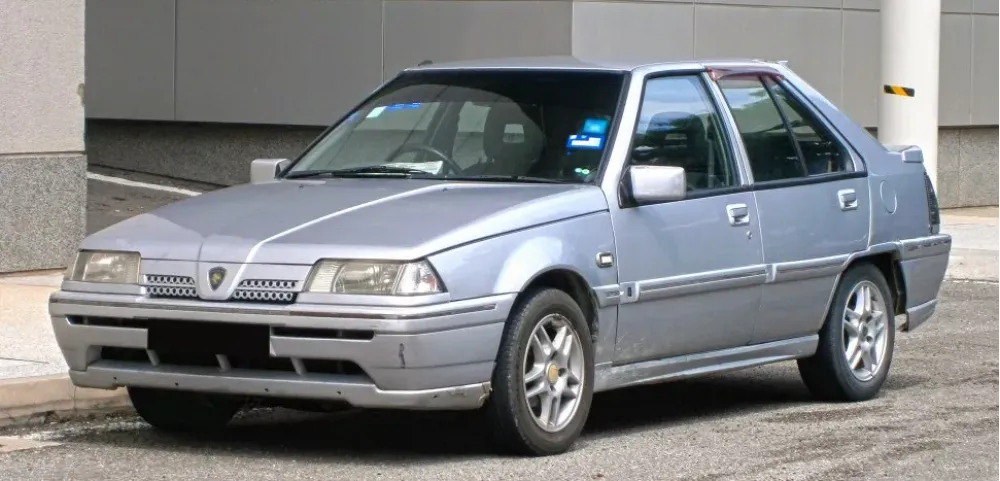
Click on image to view the full photo gallery
Proton Saga Iswara Aeroback 1.5i (90 Hp) Automatic
Overall Rating
Proton Saga Iswara:
The Proton Saga is a series of subcompact cars and currently city cars produced by Malaysian automobile manufacturer Proton. Introduced in 1985, the Proton Saga became the first Malaysian car and a major milestone in the Malaysian automotive industry. The Saga is Proton's longest-running and best-selling nameplate, with over 2 million units sold worldwide over 39 years.
The first generation Saga was developed as the result of a joint venture between HICOM and Mitsubishi Motors. It is based on the second generation Mitsubishi Lancer Fiore, and was available in 4-door saloon and 5-door hatchback guises. The second generation Proton Saga was unveiled on 18 January 2008. It is based on a stretched Proton Savvy platform and was developed in-house by Proton. The third generation Proton Saga was launched on 28 September 2016. It is based on the outgoing Saga FLX platform, and is powered by the Iriz's 1. 3-litre VVT engine....(Read more on Wikipedia)
Aeroback Overview:
Proton Saga Iswara (Aeroback). With 126 Nm of torque, it offers ample pulling power. It has moderate fuel consumption (~8.8 l/100km). Weighing only 980 kg, it’s quite light. Front‑wheel drive delivers efficiency and easy handling. Acceleration is relatively slow (0–100 km/h in 16.6 s). The top speed reaches 143 km/h. A compact car with a rear door that swings upward to provide access to the cargo area. Seating for 5 makes it ideal for daily use.
1.5i (90 Hp) Automatic Verdict:

Performance Verdict
Performance is notably hampered by the older automatic transmission, resulting in sluggish acceleration (16.6 sec 0-100km/h) and reduced responsiveness.
Fuel Economy
Suffers from higher fuel consumption (8.4 l/100 km combined) compared to its manual counterpart, making it less economical for regular use.
Pros and Cons:
Pros:
- • Affordable purchase price
- • Simple and robust Mitsubishi-derived mechanics
- • Good fuel economy (manual versions)
- • Practical hatchback body style
- • Easy to maintain and repair
Cons:
- • Outdated safety features
- • Basic interior comfort and amenities
- • Limited performance (especially automatic)
- • Dated design aesthetics
- • High fuel consumption for automatic variant
Specifications:
Specifications are compared to those of the previous generation(Saga Iswara: 1992 - 2003).
| General: | |
|---|---|
| Brand: | Proton |
| Model: | Saga Iswara |
| Generation: | Aeroback |
| Modification (Engine): | 1.5i (90 Hp) Automatic |
| Start of production: | 2001 |
| End of production: | 2003 |
| Powertrain Architecture: | Internal Combustion engine |
| Body type: | Hatchback |
| Seats: | 5 |
| Doors: | 5 |
| Engine: | |
|---|---|
| Power: | 90 Hp @ 6000 rpm. |
| Power per litre: | 61.3 Hp/l |
| Torque: | 126 Nm @ 3000 rpm. |
| Engine displacement: | 1468 |
| Number of cylinders: | 4 |
| Engine configuration: | Inline |
| Number of valves per cylinder: | 2 |
| Fuel injection system: | Multi-port manifold injection |
| Engine aspiration: | Naturally aspirated engine |
| Engine layout: | Front, Transverse |
| Cylinder Bore: | 75.5 mm mm |
| Piston Stroke: | 82 mm mm |
| Compression ratio: | 9.2:1 |
| Performance: | |
|---|---|
| Fuel Type: | Petrol (Gasoline) |
| Fuel consumption (economy) - urban: | 8.8 l/100 km |
| Fuel consumption (economy) - extra urban: | 5.7 l/100 km |
| Fuel consumption (economy) - combined: | 8.4 l/100 km |
| Acceleration 0 - 100 km/h: | 16.6 sec |
| Acceleration 0 - 62 mph: | 16.6 sec |
| Maximum speed: | 143 km/h |
| Weight-to-power ratio: | 10.9 kg/Hp, 91.8 Hp/tonne |
| Weight-to-torque ratio: | 7.8 kg/Nm, 128.6 Nm/tonne |
| Acceleration 0 - 60 mph: | 15.8 sec |
| Space: | |
|---|---|
| Kerb Weight: | 980 |
| Max. weight: | 1440 |
| Max load: | 460 |
| Trunk (boot) space - minimum: | 735 l |
| Fuel tank capacity: | 45 l |
| Size: | |
|---|---|
| Length: | 4110 mm mm [170mm less] |
| Width: | 1655 mm mm [Same width.] |
| Height: | 1360 mm mm [Same height.] |
| Wheelbase: | 2380 mm mm [Same wheelbase.] |
| Front track: | 1390 mm |
| Rear (Back) track: | 1340 mm |
| Powertrain: | |
|---|---|
| Drivetrain Architecture | The Internal combustion engine (ICE) drives the front wheels of the vehicle. |
| Drive wheel | Front wheel drive |
| Number of gears | 3 |
| Transmission type | Automatic |
| Front brakes | Disc [bad for performance and cooling.] |
| Rear brakes | Drum [bad for performance and cooling.] |
| Assisting systems | ABS (Anti-lock braking system) |
| Steering type | Steering rack and pinion |
| Power steering | Hydraulic Steering |
| Tires size | 175/70 HR13 |
| Wheel rims size | 13 |






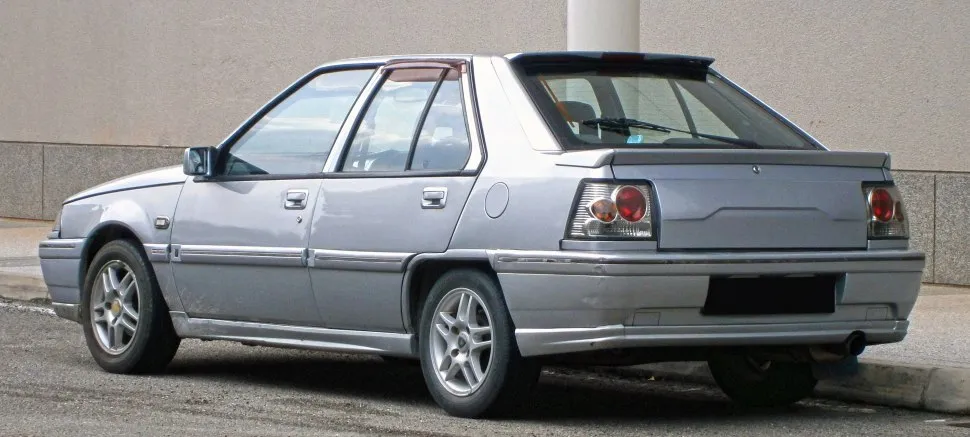
Behind the wheel of the Proton Saga Iswara. How does it handle on the road?