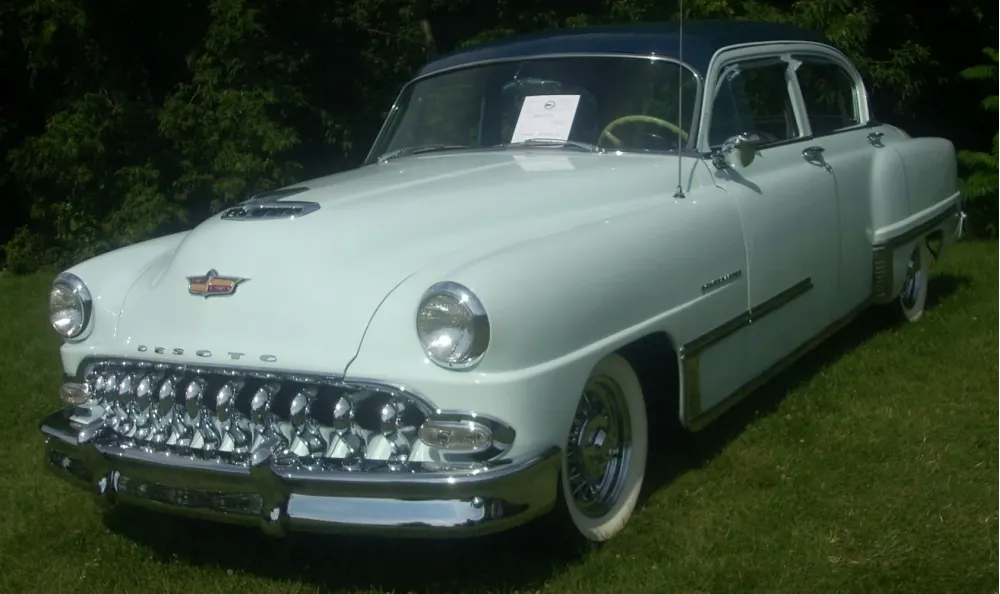
Click on image to view the full photo gallery
DeSoto Powermaster Six 4-Door Sedan 4.1 (116 Hp) PowerFlite
Overall Rating
DeSoto Powermaster Six:
The DeSoto Powermaster was an automobile built by DeSoto during model years 1952 to 1954. The car debuted during DeSoto's 25th anniversary, taking the place of the entry-level DeSoto Deluxe.
The Powermaster was a full-size car, offered in pillared two and four-door sedan and station wagon models, and powered by Chrysler's 251 cu in DeSoto I6 engine. For both of its years in production, the Powermaster was available as an eight-passenger sedan through the use of jump seats, called the DeSoto Suburban. The Powermaster was also built on a longer wheelbase ) than regular six-passenger DeSotos ). A version of the long wheelbase model was used as a basis for the DeSoto Taxi, seen in many Hollywood movies from the late 1930s through the mid-1950s....(Read more on Wikipedia)
4-Door Sedan Overview:
DeSoto Powermaster Six (4-Door Sedan). With 282 Nm of torque, it offers ample pulling power. Rear‑wheel drive offers dynamic handling and sporty feedback. A four-door car with a separate trunk, ideal for families and daily commuting. With seating for 6, it’s perfect for larger families.
4.1 (116 Hp) PowerFlite Verdict:

Performance Verdict
The 4.1L inline-six, paired with the PowerFlite automatic, offered smooth and adequate performance for daily driving in the 1950s, prioritizing comfort over outright speed.
Fuel Economy
Fuel economy for this large displacement, carbureted engine with a 2-speed automatic would be modest by modern standards, typical for American cars of its time.
Pros and Cons:
Pros:
- • Robust and reliable inline-six engine
- • Spacious and comfortable interior for six passengers
- • Smooth ride quality, typical of American sedans of the era
- • Classic American styling and presence
- • Relatively simple mechanicals for maintenance
Cons:
- • Modest fuel economy by modern standards
- • Lack of modern safety features
- • Performance is leisurely, not spirited
- • Large turning circle can be challenging in tight spaces
- • Drum brakes offer limited stopping power compared to discs
Specifications:
Specifications are compared to those of the previous generation(8-Passenger: 1952 - 1953).
| General: | |
|---|---|
| Brand: | DeSoto |
| Model: | Powermaster Six |
| Generation: | 4-Door Sedan |
| Modification (Engine): | 4.1 (116 Hp) PowerFlite |
| Start of production: | 1953 |
| End of production: | 1954 |
| Powertrain Architecture: | Internal Combustion engine |
| Body type: | Sedan |
| Seats: | 6 |
| Doors: | 4 |
| Engine: | |
|---|---|
| Power: | 116 Hp @ 3600 rpm. |
| Power per litre: | 28.3 Hp/l |
| Torque: | 282 Nm @ 1600 rpm. |
| Engine displacement: | 4105 |
| Number of cylinders: | 6 |
| Engine configuration: | Inline |
| Number of valves per cylinder: | 2 |
| Fuel injection system: | Carburettor |
| Engine aspiration: | Naturally aspirated engine |
| Engine oil capacity: | 4.7 l |
| Coolant: | 15.1 l |
| Cylinder Bore: | 87.31 mm mm |
| Piston Stroke: | 114.3 mm mm |
| Compression ratio: | 7:1 |
| Performance: | |
|---|---|
| Fuel Type: | Petrol (Gasoline) |
| Space: | |
|---|---|
| Fuel tank capacity: | 64 l |
| Size: | |
|---|---|
| Ramp-over (brakeover) angle: | 15° |
| Length: | 5448 mm mm [251mm less] |
| Width: | 1969 mm mm [6mm more] |
| Height: | 1632 mm mm [12mm more] |
| Wheelbase: | 3188 mm mm [355mm less] |
| Front track: | 1403 mm |
| Rear (Back) track: | 1438 mm |
| Front overhang: | 940 mm |
| Rear overhang: | 1321 mm |
| Ride height (ground clearance): | 178 mm |
| Minimum turning circle (turning diameter): | 12.8 m [above average] |
| Approach angle: | 23° |
| Departure angle: | 17° |
| Powertrain: | |
|---|---|
| Drivetrain Architecture | The Internal combustion engine (ICE) drives the rear wheels of the vehicle. |
| Drive wheel | Rear wheel drive |
| Number of gears | 2 |
| Transmission type | Automatic |
| Gearbox type | PowerFlite |
| Front brakes | Drum, 305 mm [bad for performance and cooling.] |
| Rear brakes | Drum, 305 mm [bad for performance and cooling.] |
| Front suspension | Independent coil spring |
| Rear suspension | Leaf spring |





Real owners, real reviews. Tell us about your DeSoto Powermaster Six.