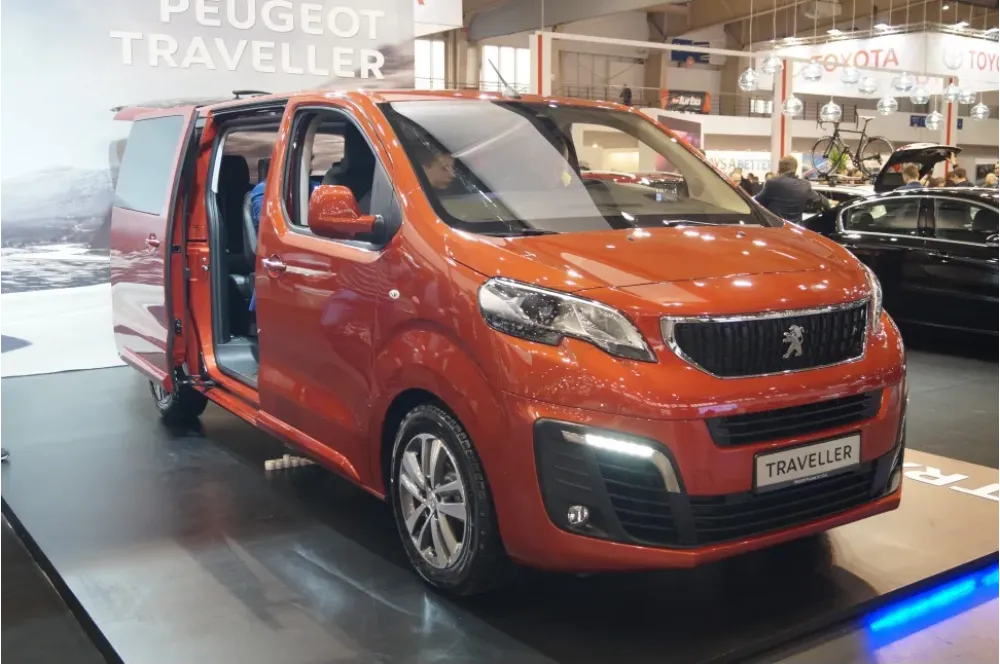
Click on image to view the full photo gallery
Peugeot Traveller L2 2.0 BlueHDi (180 Hp) EAT6
Overall Rating
Peugeot Traveller:
The Citroën Jumpy is a light commercial van jointly developed by FCA Italy and PSA Group. in 2021. ) The Jumpy is also sold as the Peugeot Expert, Fiat Scudo, Opel Vivaro, and Toyota ProAce. They were previously built by Sevel, a joint venture created in 1994 by the two companies.
All three models were facelifted in March 2004 before being replaced by new, second-generation models in 2007. The redesigned models again shared the same design and engineering, with subtle trim changes between each brand. The second generation received a small facelift in February 2012 and from July 2013, Toyota began sales of a rebadged version called the Toyota Proace....(Read more on Wikipedia)
L2 Overview:
Peugeot Traveller (L2). With 400 Nm of torque, it offers ample pulling power. It has moderate fuel consumption (~6.25 l/100km). With a weight of 1838 kg, it falls in the mid‑range. Front‑wheel drive delivers efficiency and easy handling. Acceleration is relatively slow (0–100 km/h in 10.1 s). The top speed reaches 170 km/h. A spacious vehicle designed to transport passengers comfortably, often with sliding doors. With seating for 7, it’s perfect for larger families.
The Peugeot Traveller (tested as a platform twin with Citroën Spacetourer/Toyota Proace Verso) achieved an excellent 5-star Euro NCAP rating, demonstrating strong occupant protection.
2.0 BlueHDi (180 Hp) EAT6 Verdict:

Performance Verdict
Delivers strong performance with good acceleration (10.1 seconds to 100 km/h), making it capable for all driving conditions, though the EAT6 is an older automatic.
Fuel Economy
Good fuel economy ranging from 5.7-6.0 l/100 km, though slightly less efficient than the newer EAT8 versions.
Pros and Cons:
Pros:
- • Extremely spacious and versatile interior with flexible seating options
- • Comfortable ride quality, especially on longer journeys
- • Wide range of efficient diesel engines, including powerful 2.0L options
- • Availability of all-electric e-Traveller variants for urban and eco-conscious buyers
- • Strong Euro NCAP safety rating (5 stars)
- • Practical for both large families and business shuttle services
Cons:
- • Entry-level 1.5L and 1.6L diesel engines can feel underpowered for a vehicle of this size
- • Interior materials, while durable, may not feel as premium as some rivals
- • Electric range of the e-Traveller (especially 50 kWh) might be limiting for long-distance travel
- • Some road and wind noise can be noticeable at higher speeds
- • Infotainment system can be less intuitive than competitors
Specifications:
Specifications are compared to those of the previous generation(L2: October, 2020 - April, 2024).
| General: | |
|---|---|
| Brand: | Peugeot |
| Model: | Traveller |
| Generation: | L2 |
| Modification (Engine): | 2.0 BlueHDi (180 Hp) EAT6 |
| Start of production: | September, 2016 |
| End of production: | June, 2018 |
| Powertrain Architecture: | Internal Combustion engine |
| Body type: | Minivan |
| Seats: | 7-8 |
| Doors: | 5 |
| Engine: | |
|---|---|
| Engine systems: | Particulate filter |
| Power: | 180 Hp @ 4000 rpm. [0hp less] |
| Power per litre: | 90.1 Hp/l [worst than previous generation] |
| Torque: | 400 Nm @ 2000 rpm. |
| Engine Model/Code: | AHH DW10FC More details about the engine AHH DW10FC |
| Engine displacement: | 1997 |
| Number of cylinders: | 4 |
| Engine configuration: | Inline |
| Number of valves per cylinder: | 4 |
| Fuel injection system: | Diesel Commonrail |
| Engine aspiration: | Turbocharger, Intercooler |
| Engine oil capacity: | 5 l |
| Engine layout: | Front, Transverse |
| Cylinder Bore: | 85 mm mm |
| Piston Stroke: | 88 mm mm |
| Performance: | |
|---|---|
| Fuel Type: | Diesel |
| Fuel consumption (economy) - urban: | 6.1-6.4 l/100 km |
| Fuel consumption (economy) - extra urban: | 5.4-5.7 l/100 km |
| Fuel consumption (economy) - combined (NEDC): | 5.7-6.0 l/100 km |
| Fuel consumption (economy) - urban (NEDC): | 6.1-6.4 l/100 km |
| Fuel consumption (economy) - extra urban (NEDC): | 5.4-5.7 l/100 km |
| Fuel consumption (economy) - combined: | 5.7-6.0 l/100 km |
| Emission standard: | Euro 6 |
| Acceleration 0 - 100 km/h: | 10.1 sec |
| Acceleration 0 - 62 mph: | 10.1 sec |
| Maximum speed: | 170 km/h |
| Weight-to-power ratio: | 9.6 kg/Hp, 104 Hp/tonne |
| Weight-to-torque ratio: | 4.3 kg/Nm, 231.2 Nm/tonne |
| Acceleration 0 - 60 mph: | 9.6 sec |
| Space: | |
|---|---|
| Kerb Weight: | 1730-1946 |
| Max. weight: | 2810 |
| Max. roof load: | 140-170 kg |
| Max load: | 864-1080 |
| Permitted trailer load with brakes (12%): | 2000 kg |
| Fuel tank capacity: | 69 l |
| AdBlue tank: | 22.4 l |
| Size: | |
|---|---|
| Length: | 4956 mm mm [3mm less] |
| Width: | 1920 mm mm [Same width.] |
| Height: | 1890 mm mm [13mm more] |
| Wheelbase: | 3275 mm mm [Same wheelbase.] |
| Width with mirrors folded: | 2010 mm |
| Width including mirrors: | 2204 mm |
| Front overhang: | 881 mm |
| Minimum turning circle (turning diameter): | 12.9 m [above average] |
| Powertrain: | |
|---|---|
| Drivetrain Architecture | The Internal combustion engine (ICE) drives the front wheels of the vehicle. |
| Drive wheel | Front wheel drive |
| Number of gears | 6 |
| Transmission type | Automatic |
| Front brakes | Ventilated discs [Best for performance and cooling.] |
| Rear brakes | Disc [above average] |
| Assisting systems | ABS (Anti-lock braking system) |
| Steering type | Steering rack and pinion |
| Tires size | 215/60 R17 |
| Wheel rims size | 17 |
| Front suspension | Independent type McPherson |
| Rear suspension | Independent coil spring |






Fuel, speed, and comfort: How does the Peugeot Traveller rank in your book?