
Click on image to view the full photo gallery
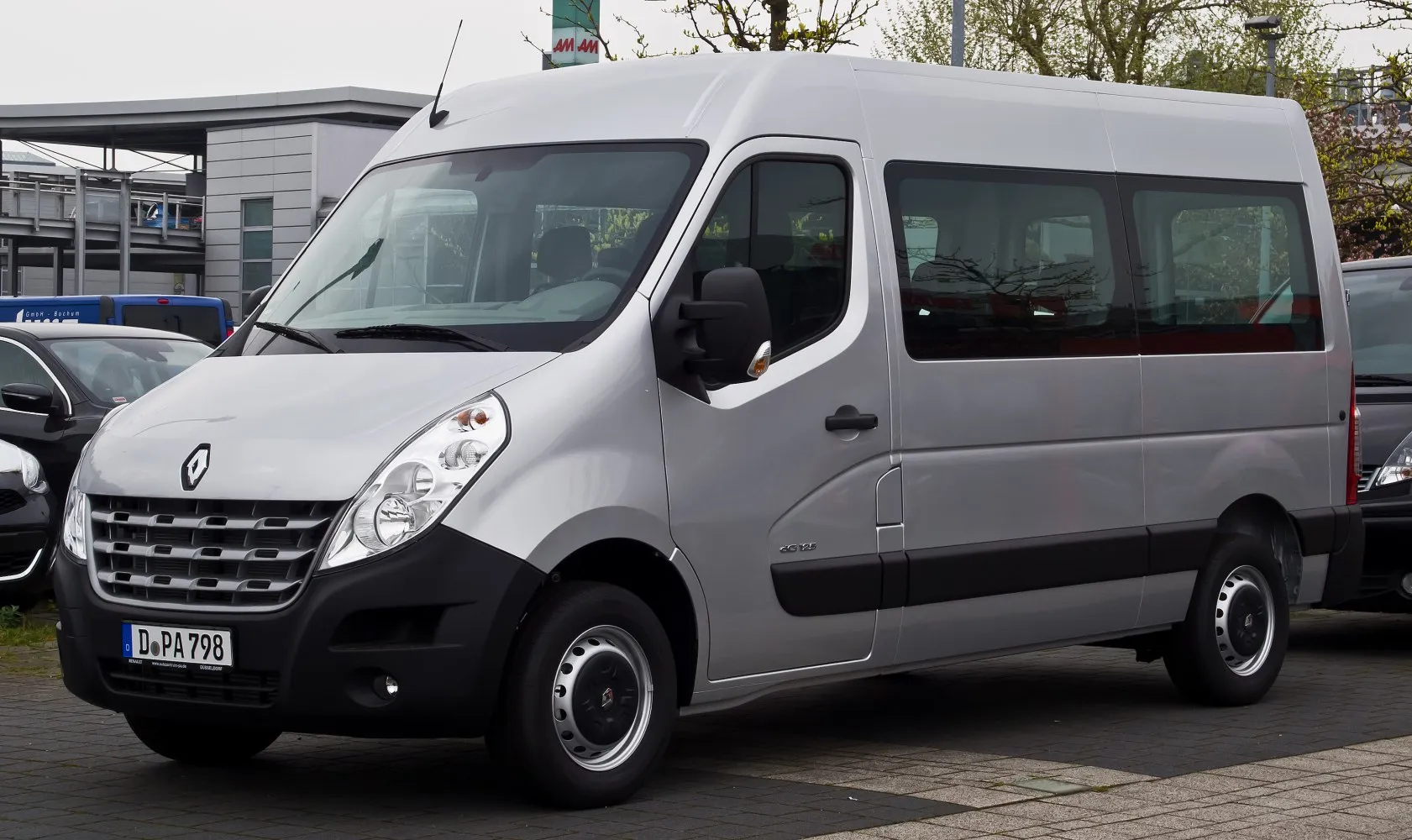
Renault Master III (Phase III, 2019) Panel Van 2.3 Energy dCi (180 Hp) L2H2 Automatic
Overall Rating
Renault Master:
The Renault Master is a large van produced by the French manufacturer Renault since 1980, now in its fourth generation. It replaced the earlier Renault Super Goélette light trucks. It is also sold as the Nissan Interstar. Opel and Vauxhall have sold versions of the second and third series vans as the Opel Movano in Continental Europe and Vauxhall Movano in the United Kingdom. All four generations have been designed and manufactured by Renault, irrespective of the brand. Renault Trucks markets it as the Renault Trucks Master....(Read more on Wikipedia)
III (Phase III, 2019) Panel Van Overview:
Renault Master (III (Phase III, 2019) Panel Van). With 400 Nm of torque, it offers ample pulling power. It has moderate fuel consumption (~7.618 l/100km). With a weight of 1971 kg, it falls in the mid‑range. Front‑wheel drive delivers efficiency and easy handling. Acceleration is relatively slow (0–100 km/h in 11.3 s). The top speed reaches 165 km/h. A spacious vehicle designed to transport passengers comfortably, often with sliding doors. A multi-purpose vehicle designed to transport passengers with ample interior space. Seating for 3 makes it ideal for daily use.
2.3 Energy dCi (180 Hp) L2H2 Automatic Verdict:

Performance Verdict
The powerful 180 Hp engine paired with an automatic transmission in the L2H2 offers strong performance and ease of driving for demanding routes and loads.
Fuel Economy
Achieves 6.825 l/100 km, which is efficient for a high-power automatic, providing a good balance of performance and running costs.
Pros and Cons:
Pros:
- • Extensive range of powerful and efficient diesel engines.
- • High cargo volume and payload capacity across various body configurations.
- • Available electric variant for urban, zero-emission operations.
- • Improved interior and technology in Phase III.
- • Strong reputation for durability and commercial reliability.
Cons:
- • Limited range for the electric variant (33 kWh).
- • Acceleration data missing for several diesel trims.
- • Standard panel van comfort may not suit all drivers for long journeys.
- • No official Euro NCAP crash test star rating for this specific panel van generation.
- • Fuel economy can vary significantly with load and driving style.
Specifications:
Specifications are compared to those of the previous generation(III (Phase II, 2014) Combi: 2018 - 2019).
| General: | |
|---|---|
| Brand: | Renault |
| Model: | Master |
| Generation: | III (Phase III, 2019) Panel Van |
| Modification (Engine): | 2.3 Energy dCi (180 Hp) L2H2 Automatic |
| Start of production: | 2019 |
| Powertrain Architecture: | Internal Combustion engine |
| Body type: | Minivan, MPV |
| Seats: | 3 |
| Doors: | 4 |
| Engine: | |
|---|---|
| Engine systems: | Start & Stop System |
| Power: | 180 Hp @ 3500 rpm. |
| Power per litre: | 78.3 Hp/l |
| Torque: | 400 Nm @ 1500 rpm. |
| Engine Model/Code: | M9T [Same engine] More details about the engine M9T |
| Engine displacement: | 2298 |
| Number of cylinders: | 4 |
| Engine configuration: | Inline |
| Number of valves per cylinder: | 4 |
| Fuel injection system: | Diesel Commonrail |
| Engine aspiration: | Twin-Turbo, Intercooler |
| Coolant: | 11 l |
| Performance: | |
|---|---|
| Fuel Type: | Diesel |
| Fuel consumption (economy) - urban: | 7.618 l/100 km |
| Fuel consumption (economy) - extra urban: | 6.363 l/100 km |
| Combined fuel consumption (WLTP): | 9.6 l/100 km |
| Fuel consumption (economy) - urban (NEDC, WLTP equivalent): | 7.618 l/100 km |
| Fuel consumption (economy) - extra urban (NEDC, WLTP equivalent): | 6.363 l/100 km |
| Fuel consumption (economy) - combined (NEDC, WLTP equivalent): | 6.825 l/100 km |
| Fuel consumption (economy) - combined: | 6.825 l/100 km |
| Emission standard: | Euro 6d-Temp |
| Acceleration 0 - 100 km/h: | 11.3 sec |
| Acceleration 0 - 62 mph: | 11.3 sec |
| Maximum speed: | 165 km/h |
| Weight-to-power ratio: | 11 kg/Hp, 91.3 Hp/tonne |
| Weight-to-torque ratio: | 4.9 kg/Nm, 202.9 Nm/tonne |
| Acceleration 0 - 60 mph: | 10.7 sec |
| Space: | |
|---|---|
| Kerb Weight: | 1971 |
| Max. weight: | 3500 |
| Max load: | 1529 |
| Trunk (boot) space - maximum: | 10800 l |
| Permitted trailer load with brakes (12%): | 2500 kg |
| Fuel tank capacity: | 105 l |
| AdBlue tank: | 28 l |
| Permitted trailer load without brakes: | 750 kg |
| Size: | |
|---|---|
| Length: | 5575 mm [27mm more] |
| Width: | 2070 mm [Same width.] |
| Height: | 2499 mm [4mm more] |
| Wheelbase: | 3682 mm [Same wheelbase.] |
| Width including mirrors: | 2470 mm |
| Front track: | 1750 mm |
| Rear (Back) track: | 1730 mm |
| Front overhang: | 869 mm |
| Rear overhang: | 1024 mm |
| Ride height (ground clearance): | 182 mm |
| Minimum turning circle (turning diameter): | 14.1 m [above average] |
| Powertrain: | |
|---|---|
| Drivetrain Architecture | The Internal combustion engine (ICE) drives the front wheels of the vehicle. |
| Drive wheel | Front wheel drive |
| Number of gears | 6 |
| Transmission type | Automatic |
| Front brakes | Ventilated discs, 302 mm [Best for performance and cooling.] |
| Rear brakes | Disc, 305 mm [above average] |
| Tires size | 225/65 R16 |
| Wheel rims size | 16 |
| Front suspension | Independent, type McPherson with coil spring and anti-roll bar |
| Rear suspension | Leaf spring |





Help others decide – share your experience!