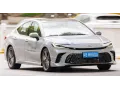
Toyota Camry VI (XV40, facelift 2009) 2.4 (187 Hp) Hybrid e-CVT
People\'s Opinion
N/A / 5
Toyota Camry:
The Toyota Camry is an automobile sold internationally by the Japanese auto manufacturer Toyota since 1982, spanning multiple generations. Originally compact in size , the Camry has grown since the 1990s to fit the mid-size classification —although the two widths co-existed in that decade. Since the release of the wide-bodied versions, Camry has been extolled by Toyota as the firm's second "world car" after the Corolla. As of 2022, the Camry is positioned above the Corolla and below the Avalon or Crown in several markets....(Read more on Wikipedia)
VI (XV40, facelift 2009) Overview:
Toyota Camry (VI (XV40, facelift 2009)). With 187 Nm of torque, it offers ample pulling power. It has moderate fuel consumption (~7.1 l/100km). With a weight of 1662 kg, it falls in the mid‑range. Front‑wheel drive delivers efficiency and easy handling. A four-door car with a separate trunk, ideal for families and daily commuting. Seating for 5 makes it ideal for daily use.
Performance Verdict
Combines electric and petrol power for smooth, responsive acceleration, particularly strong off the line, with a total system output of 187 Hp.
Fuel Economy
Offers outstanding fuel economy for a mid-size sedan, especially in urban driving, making it a highly efficient and environmentally conscious option.
Best Use Case:
City / Mixed
Pros and Cons:
Pros:
- • Exceptional reliability and durability across all powertrains.
- • Spacious and comfortable interior, ideal for families and long journeys.
- • Smooth and quiet ride quality, enhancing passenger comfort.
- • Excellent fuel economy with the Hybrid model, a class leader.
- • Strong resale value, making it a smart long-term investment.
Cons:
- • Steering can feel numb and unengaging, lacking driver feedback.
- • Interior design is functional but lacks excitement or premium feel.
- • Base models can feel underpowered for some drivers' preferences.
- • Not tested by Euro NCAP, which might be a concern for some European buyers.
- • Exterior styling is conservative, blending into traffic rather than standing out.
Specifications:
Specifications are compared to those of the previous generation(Solara II Convertible (facelift 2006): 2006 - 2008).
| General: |
| Brand: | Toyota |
|---|
| Model: | Camry |
|---|
| Generation: | VI (XV40, facelift 2009) |
|---|
| Modification (Engine): | 2.4 (187 Hp) Hybrid e-CVT |
|---|
| Start of production: | 2009 |
|---|
| End of production: | 2011 |
|---|
| Powertrain Architecture: | FHEV (Full Hybrid Electric Vehicle) |
|---|
| Body type: | Sedan |
|---|
| Seats: | 5 |
|---|
| Doors: | 4 |
|---|
| Engine: |
| Power: | 147 Hp @ 6000 rpm. Same horsepower |
|---|
| Power per litre: | 62.2 Hp/l [84mm less] |
|---|
| Torque: | 187 Nm @ 4400 rpm. |
|---|
| Engine Model/Code: | 2AZ-FXE More details about the engine 2AZ-FXE |
|---|
| Engine displacement: | 2362 |
|---|
| Number of cylinders: | 4 |
|---|
| Engine configuration: | Inline |
|---|
| Number of valves per cylinder: | 4 |
|---|
| Fuel injection system: | Multi-port manifold injection |
|---|
| Engine aspiration: | Naturally aspirated engine |
|---|
| Valvetrain: | DOHC, Dual VVT-i |
|---|
| Engine oil capacity: | 4.3 l |
|---|
| Coolant: | 6.2 l |
|---|
| Engine layout: | Front, Transverse |
|---|
| Cylinder Bore: | 88.3 mm mm |
|---|
| Piston Stroke: | 96.5 mm mm |
|---|
| Compression ratio: | 12.5:1 |
|---|
| Performance: |
| Fuel Type: | Petrol (Gasoline) |
|---|
| Fuel consumption (economy) - urban: | 7.1 l/100 km |
|---|
| Fuel consumption (economy) - extra urban: | 6.9 l/100 km |
|---|
| Fuel consumption (economy) - combined: | 6.9 l/100 km |
|---|
| Emission standard: | AT-PZEV |
|---|
| Weight-to-power ratio: | 8.9 kg/Hp, 112.5 Hp/tonne |
|---|
| Weight-to-torque ratio: | 8.9 kg/Nm, 112.5 Nm/tonne |
|---|
| Space: |
| Kerb Weight: | 1662 |
|---|
| Trunk (boot) space - minimum: | 300 l |
|---|
| Fuel tank capacity: | 65 l |
|---|
| Size: |
| Length: | 4806 mm mm [84mm less] |
|---|
| Width: | 1821 mm mm [5mm more] |
|---|
| Height: | 1460 mm mm [35mm more] |
|---|
| Wheelbase: | 2776 mm mm [106mm more] |
|---|
| Front track: | 1575 mm |
|---|
| Rear (Back) track: | 1565 mm |
|---|
| Ride height (ground clearance): | 150 mm |
|---|
| Minimum turning circle (turning diameter): | 11.0 m [above average] |
|---|
| Powertrain: |
| Drivetrain Architecture | The Internal combustion engine (ICE) and electric motor drive the front wheels of the car with the ability to work in full electric or mixed mode. |
|---|
| Drive wheel | Front wheel drive |
|---|
| Transmission type | Automatic |
|---|
| Gearbox type | e-CVT |
|---|
| Front brakes | Ventilated discs, 294 mm [Best for performance and cooling.] |
|---|
| Rear brakes | Disc, 279 mm [above average] |
|---|
| Assisting systems | ABS (Anti-lock braking system) |
|---|
| Steering type | Steering rack and pinion |
|---|
| Power steering | Electric Steering |
|---|
| Tires size | 215/60 R16 |
|---|
| Wheel rims size | 6.5J x 16 |
|---|
| Front suspension | Independent, type McPherson with coil spring and anti-roll bar |
|---|
| Rear suspension | Independent multi-link spring suspension with stabilizer |
|---|
| Electric: |
| Battery technology: | Nickel-metal hydride (NiMH) |
|---|
| Battery location: | Behind the back wall of the passenger cabin |
|---|
| System power: | 187 Hp |
|---|
| Electric motor power: | 143 Hp @ 4500 rpm. |
|---|
| Electric motor Torque: | 270 Nm @ 0-1500 rpm. |
|---|
| Electric motor location: | Integrated into the transmission |
|---|
| Electric motor type: | Synchronous |
|---|
| Battery voltage: | 244.8 V |
|---|







Driven it? Loved it? Hated it? Share your honest review!